In brief: Pattaya's infrastructure projects – led by U-Tapao Airport, the high-speed rail linking three airports, and the eight-lane motorway expansion within the Eastern Economic Corridor (EEC) – are making the region increasingly accessible for DACH buyers and providing sustainable support for property prices. Since construction at U-Tapao officially began on 3 April 2026, what was once a plan has become tangible reality. Buyers who get into well-located new developments early stand to benefit from the long-term value creation that this location upgrade brings.
Why infrastructure is Pattaya's strongest price driver
Property prices follow accessibility over the long term. Bringing a region closer to airports, high-speed rail and motorways attracts people, businesses and capital – and that is exactly what is happening around Pattaya. The city sits at the heart of the Eastern Economic Corridor (EEC), Thailand's largest economic and infrastructure programme, which aims to develop the provinces of Chonburi, Rayong and Chachoengsao into a high-tech hub for Asia.
For DACH buyers, this is the real story behind Pattaya's infrastructure projects: it is not about short-term headlines, but about an upgrade playing out over a decade – one that means shorter travel times, more jobs and a growing, affluent residential population. These three effects converge directly on a market with limited buildable land in the best coastal locations – a classic foundation for rising values.
U-Tapao: Pattaya's own international airport
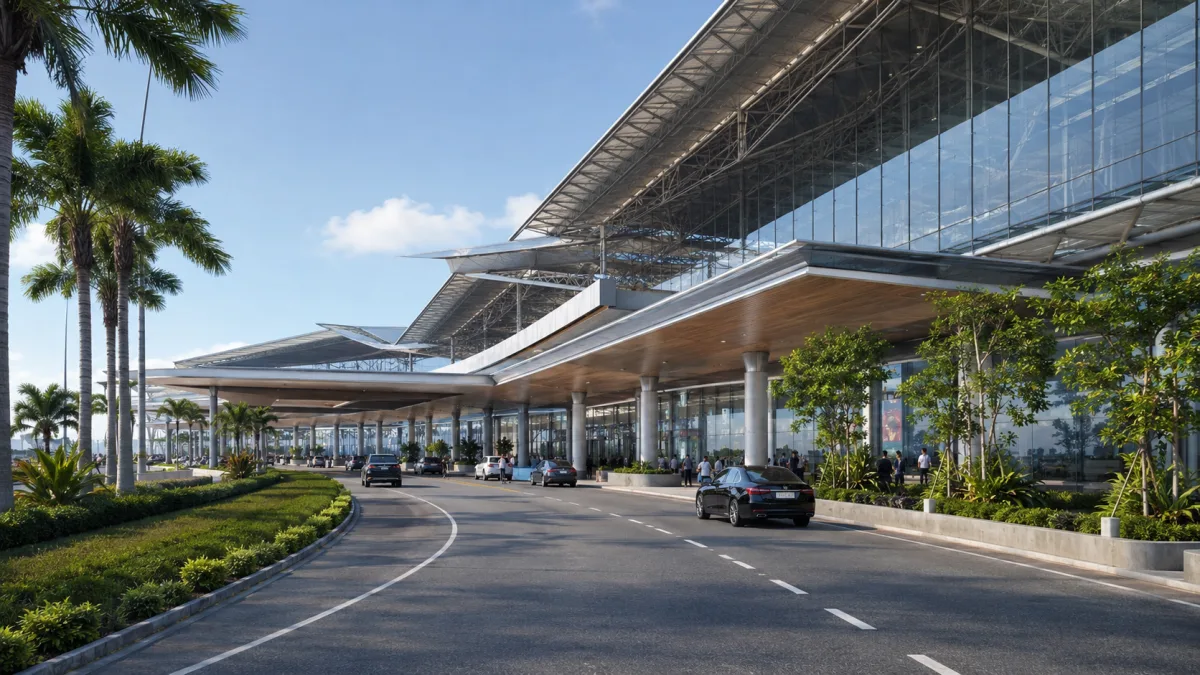
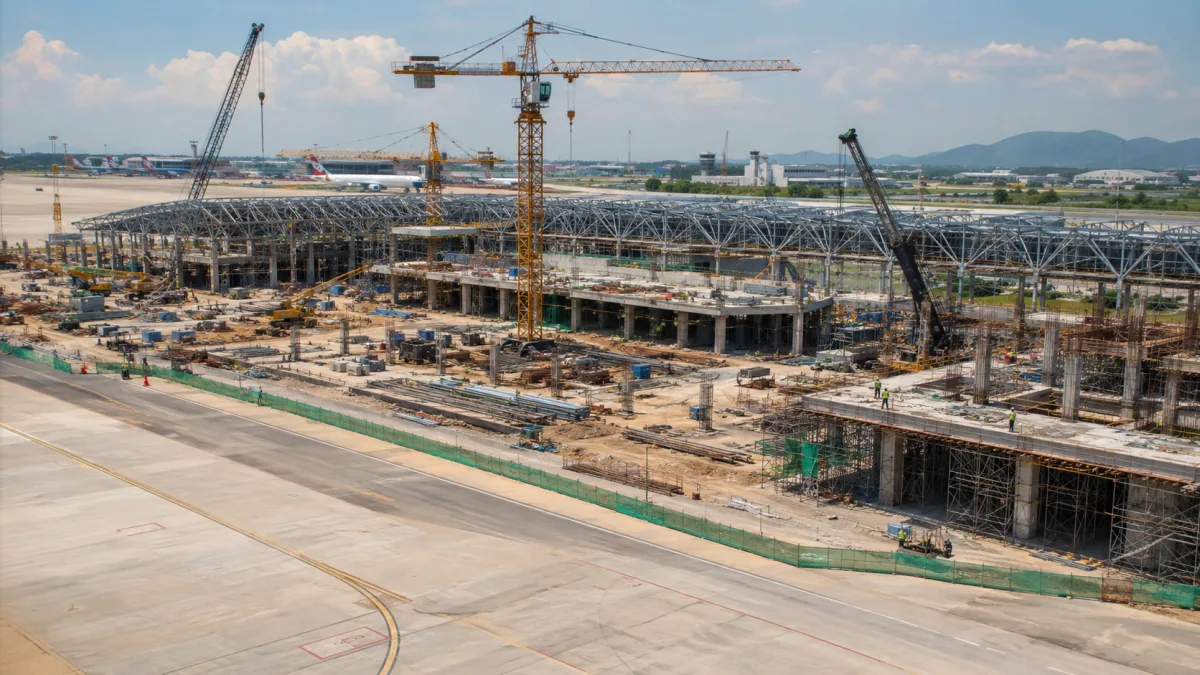
The centrepiece of the EEC initiative is the expansion of U-Tapao–Rayong–Pattaya Airport into an "Eastern Aviation City". After years of preparation, the project officially broke ground on 3 April 2026 – a turning point that is as significant psychologically as it is economically. The total investment stands at approximately 290 billion baht (around €7.4 billion).
Today, U-Tapao handles only around 300,000 to 400,000 passengers per year. The first expansion phase will deliver a new terminal for 3 to 4 million travellers, plus a second runway (targeted completion: end of October 2028). At full build-out, the airport is designed for a capacity of approximately 60 million passengers per year, with the opening of the first phase targeted for around 2031.
For Pattaya, this means a fully-fledged international airport on the doorstep – just 30 to 45 minutes by car from the southern districts. For buyers in Jomtien and Na Jomtien, the journey to the airport will be noticeably shorter than to Suvarnabhumi in Bangkok. For more on the specific impact mechanism of U-Tapao, read our article on EEC infrastructure as an investment driver.
High-speed rail: three airports, one hour to Bangkok
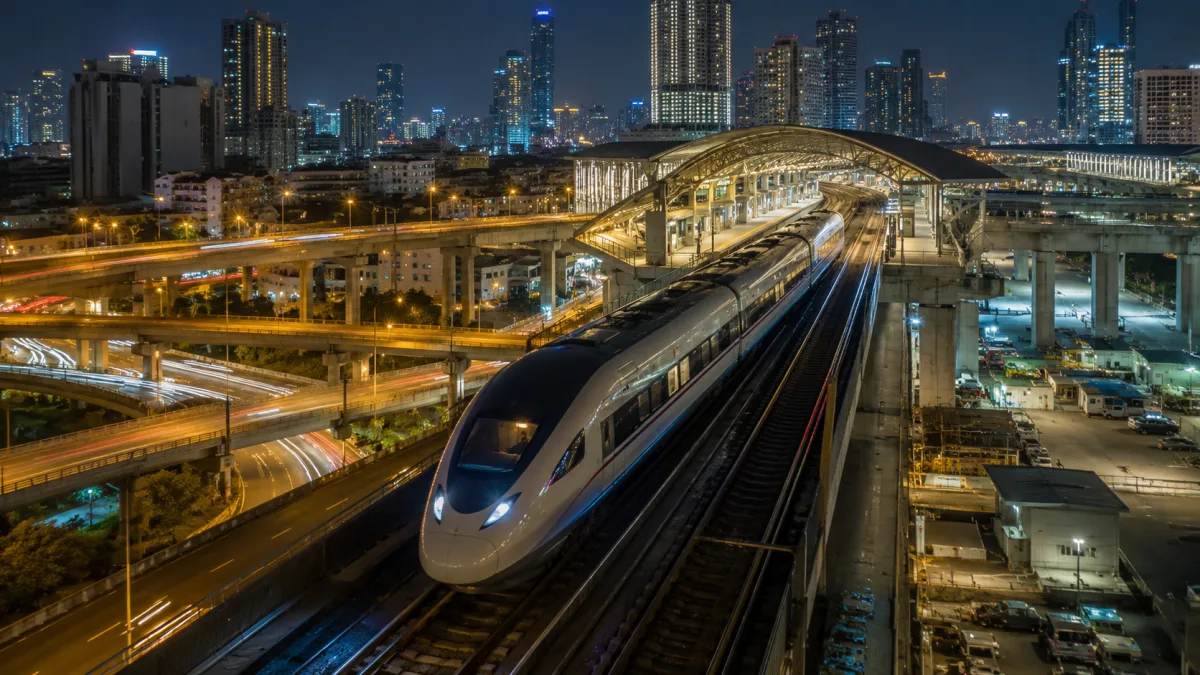
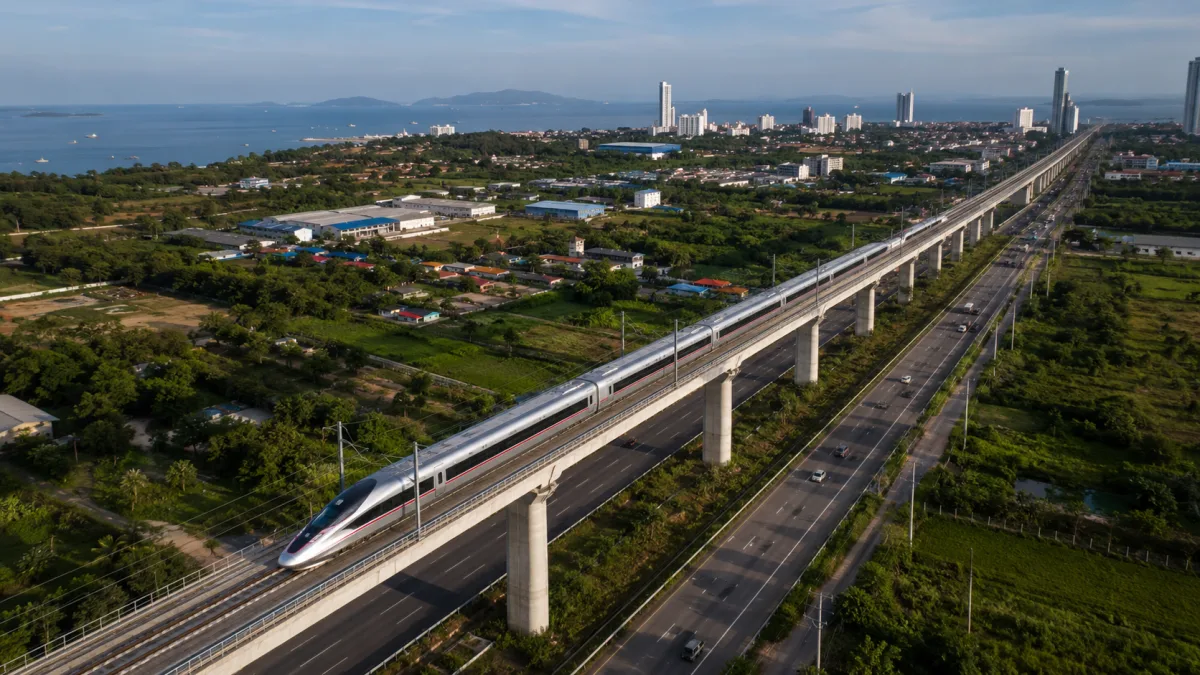
The second major project is the high-speed rail line connecting Don Mueang, Suvarnabhumi and U-Tapao. With a budget of approximately 224.5 billion baht, it forms the transport backbone of the EEC. Trains are expected to run at up to 250 km/h, cutting travel time between Bangkok and the Pattaya region to around one hour.
After a lengthy planning phase, contract signing is scheduled for July 2026, with a Notice to Proceed expected to follow in August 2026. The State Railway of Thailand (SRT) then anticipates a construction and testing period of approximately 5.5 years, with operations commencing around 2032. A dedicated HSR station is planned for the Pattaya region, which will greatly simplify daily commuting and weekend use between the capital and the coast.
This connectivity is progressively transforming Pattaya into a kind of "executive suburb" of Bangkok: those who work in the capital can live by the sea. This broadens the pool of tenants and buyers well beyond the traditional mix of tourists and retirees – an important consideration when making a realistic assessment of rental yields.
Motorway expansion: the fast road is already here
While the airport and rail line are still under construction, one piece of the puzzle is already fully operational: the eight-lane Intercity Motorway No. 7. The 32-kilometre extension from Pattaya to Map Ta Phut (Rayong) was built at a cost of around 17.8 billion baht and has been open since 2020. Via the Huai Yai, Khao She-ohn and U-Tapao interchanges, it links Pattaya directly to Sattahip, the airport and the Map Ta Phut industrial zone.
This Bangkok – Chonburi – Pattaya – Rayong corridor already forms a continuous high-performance road today. For property owners, this means: accessibility by car is already genuinely improved, long before the rail and airport reach full operation. Every further infrastructure milestone builds on this existing foundation.
Smart City and EEC: the big picture
U-Tapao, the rail line and the motorway are embedded within the broader EEC programme, which takes a Smart City approach: expansion of the deep-sea ports at Laem Chabang and Map Ta Phut, digital infrastructure, subsidised high-tech industries (automotive, electronics, medical, aerospace) and education and research clusters. The goal is to attract skilled professionals and multinational companies to the region.
For the residential market, this is crucial: industrial growth in Rayong and Chonburi creates jobs, and a portion of the resulting management and specialist workforce seeks high-quality accommodation with a strong quality of life – which Pattaya offers with its beaches, services and infrastructure. This generates a demand stream that is less dependent on tourism and helps support both rents and values.
Overview: the four drivers at a glance
| Project | Volume (approx.) | Status / Target year | Effect for Pattaya |
|---|---|---|---|
| U-Tapao Airport & Aviation City | 290 bn THB | Construction started 04/2026, Phase 1 ~2031 | International airport on the doorstep |
| High-speed rail – 3 airports | 224.5 bn THB | Contract 07/2026, operations ~2032 | Approx. 1 hour to Bangkok, new commuter base |
| Motorway 7 (Pattaya–Map Ta Phut) | 17.8 bn THB | Operational since 2020 | Direct high-performance road, already real |
| Ports, Smart City, high-tech industry | EEC overall programme | Ongoing | Jobs, affluent residential population |
What this means in concrete terms for property prices
The Pattaya market presents itself in 2026 as mature and stable: steady, moderate appreciation rather than speculative spikes. The average price per square metre stands at around 70,000 THB, while new developments in sought-after locations sit considerably higher. Over the long term, approximately 3 to 5% capital appreciation per year is expected for well-located properties.
It is important to distinguish clearly between the different drivers. These three levers operate independently of one another:
- Ongoing market price appreciation: around 3–5% p.a. for good locations – the general trend that infrastructure supports.
- Off-plan price advantage: In the early construction phase, new developments can be up to 40% cheaper than at completion. This is a one-off value creation driven by construction progress – not an ongoing yield.
- Rental yield: gross approximately 5–8% p.a., generated from letting – separate from capital appreciation.
Infrastructure acts primarily on the first point: it lifts the baseline of entire locations over years. Buying today in a zone that will benefit from U-Tapao and the future rail station locks in the "before" price level. For a breakdown of price ranges by district, current figures are available in the Pattaya Off-Plan Price Report 2026, and how the market is likely to develop in 2026/2027 is examined in our forecast for DACH investors.
Which locations benefit the most
Not every location gains equally. The best-positioned areas are the southern, airport-adjacent districts and established coastal locations with limited new development potential:
| Location | New-build price range (THB/m²) | Infrastructure connection |
|---|---|---|
| Jomtien | 125,000–220,000 | Short distance to U-Tapao, substantial off-plan activity |
| Na Jomtien | 115,000–247,000 | Closest to the airport, development momentum |
| Pratumnak Hill | 120,000–200,000 | Established premium location, scarce buildable land |
| Wongamat / Naklua | 115,000–260,000 (top 300,000+) | Top beachfront location, high demand |
| Central Pattaya | 130,000–250,000 | Central connectivity, rail station within reach |
Specific projects in these zones include Aquarous Jomtien (Foreign Quota 138,000–217,000 THB/m²), Grand Solaire Noble (142,000–219,000 THB/m²), or browse the full project overview. At the current exchange rate (approximately 38–39 THB/€), studios start from around €100,000, one-bedroom units range from approximately €120,000–170,000, and two-bedroom units from €180,000–250,000.
Off-plan in an infrastructure environment: setting the course now
The combination of an infrastructure boost and an off-plan purchase is particularly attractive for DACH buyers. You lock in today's prices, spread payments comfortably via a developer payment plan, and benefit twice during the construction period: from the progress of the building itself and from the location's appreciation as the airport and rail line take shape. Our guide to buying off-plan in Pattaya explains how such a purchase works step by step; for financing, see the article on payment plans and financing.
Selecting the right developer is my job – and I am on the ground to do it. With a new-build from a vetted developer, the contracts are standardised; unlike a private resale purchase, engaging your own lawyer is generally not necessary. This saves you time and cost, and is a clear advantage of the new-build route.
Frequently asked questions about Pattaya's infrastructure and property prices
When will U-Tapao Airport be completed?
Construction officially began on 3 April 2026. The first expansion phase, with a new terminal (3–4 million passengers) and a second runway, is targeted for around 2031, with the runway itself due to be completed by the end of 2028. Full build-out capacity is planned at approximately 60 million passengers.
When will the high-speed train to Pattaya start running?
Contract signing is scheduled for July 2026, with construction starting shortly afterwards. The State Railway expects operations to begin around 2032. The line connects the three airports Don Mueang, Suvarnabhumi and U-Tapao, cutting the Bangkok–Pattaya journey to approximately one hour.
Will the infrastructure cause property prices in Pattaya to rise?
The projects provide long-term price support by improving accessibility, creating jobs and increasing residential demand. A realistic expectation is approximately 3–5% capital appreciation per year for well-located properties – a steady trend, not a guarantee. Prices are indicative; this is not investment advice.
Which districts benefit the most?
Particularly the southern, airport-adjacent areas of Jomtien and Na Jomtien, as well as established premium zones such as Pratumnak and Wongamat where buildable land is scarce. These areas combine an infrastructure boost with limited supply.
Is buying off-plan worthwhile because of the infrastructure?
For many buyers, yes: in the early construction phase, new developments can be up to 40% cheaper than at completion, and location appreciation adds further upside. Choosing the right developer and the right location is crucial – and I will guide you through that personally.
Would you like to know which location and project best match your goals? I am happy to advise you personally and without obligation via the contact form. You will also find in-depth background on the buying process, legal aspects and financing in my free guide – presented in a concise format for DACH buyers.
Free Guide
68 pages of Pattaya insider knowledge — download for free