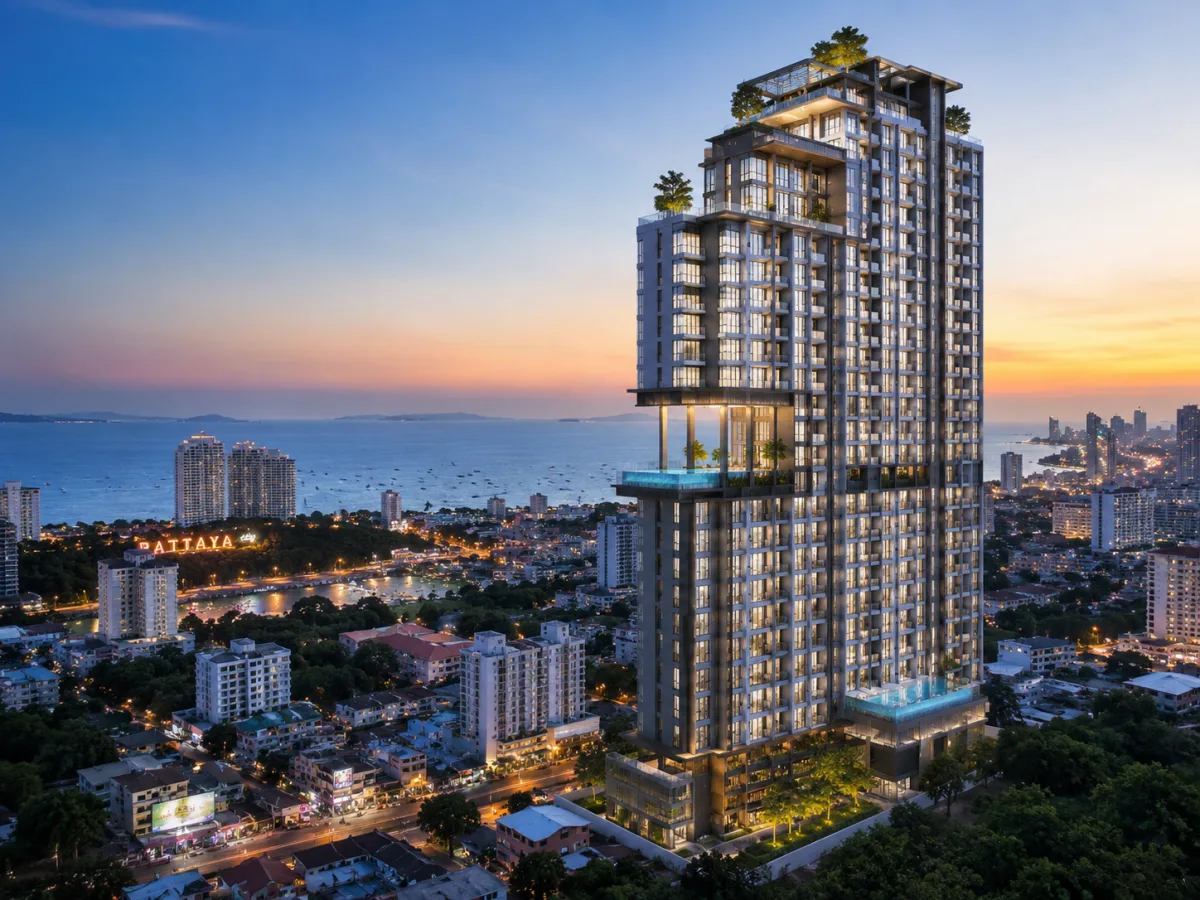
In short: When selling a condo in Pattaya, four items are settled at the Land Office: transfer fee (2%), either Specific Business Tax (3.3%) or stamp duty (0.5%) depending on the holding period, and withholding tax. Anyone who has owned the property for more than five years avoids the expensive Specific Business Tax. As a seller, budget for roughly 2–6% of the official assessed value – who pays what is negotiable and should be set out in the sales contract.
Which Selling Taxes Apply to a Condo in Pattaya
Unlike in Germany, Thailand has no separate real-estate acquisition tax and no classic speculation tax with a ten-year period. Instead, several fees and taxes fall due simultaneously at the Land Department (Thailand's land registry) when ownership is transferred. All of them are settled in cash or by cashier's cheque on the day of the title transfer, before the new title document is issued.
Important to note upfront: the basis for calculation is in most cases not your actual sale price but the official appraised value of the Land Office – or the sale price, whichever is higher. This official value is frequently below the market price, which in practice reduces the tax burden. The same rules apply to private resales of off-plan and new-build properties after completion.
The Four Items at a Glance
- Transfer Fee: 2% of the official appraised value. It is customary for buyer and seller to split this equally (1% each), but this is purely a matter of negotiation.
- Specific Business Tax (SBT): 3.3% of the higher of the sale price or appraised value – payable if you have owned the condo for less than five years.
- Stamp Duty: 0.5% – only applies when no SBT is due (i.e. from five years of ownership onwards). The two are mutually exclusive.
- Withholding Tax: a prepaid income tax on the gain from the sale. For individuals it is progressive and scaled by holding period; for companies it is a flat 1%.

Transfer Fee in Pattaya: Who Pays the 2%?
The 2% transfer fee is the only true "fee" item and always applies. There is no legal rule dictating who bears it – market practice is for buyer and seller to split it equally (1% each). When buying a new build directly from the developer, the developer often covers all or part of the transfer fee as a sales incentive; in private sales it is freely negotiated.
A note on economic stimulus measures: Thailand temporarily reduced the transfer fee for residential properties up to 7,000,000 THB to 0.01%. This concession expires in mid-2026 and applies exclusively to Thai nationals – as a DACH seller of a condo in the foreign quota you cannot count on it and should conservatively budget for the full 2%.
The 5-Year Holding Period: SBT or Stamp Duty
This is where it is decided whether your sale is cheap or expensive. The Specific Business Tax of 3.3% (3% SBT plus a 10% municipal surcharge on top) is payable when the authorities consider the transaction to be a commercial or speculative deal – and the tax authority assumes exactly that if you have owned the property for less than five years.
If, on the other hand, you hold the condo for five years or longer, the SBT is waived entirely. Instead you pay only the considerably cheaper stamp duty of 0.5%. The two taxes are mutually exclusive: only one of the two ever applies, never both at the same time.
The Difference in Numbers
| Holding Period | SBT (3.3%) | Stamp Duty (0.5%) | Difference at 5,500,000 THB |
|---|---|---|---|
| Under 5 years | yes | no | 181,500 THB |
| 5 years or more | no | yes | 27,500 THB |
On a condo valued at 5,500,000 THB (approximately 145,000 €), the five-year holding period therefore saves around 154,000 THB – roughly 4,000 € on this single item alone. For investors this is a strong argument for planning off-plan purchases with a medium- to long-term horizon rather than aiming for a quick resale.
Special rule: Even those who hold a condo for less than five years may be exempt from SBT if they have been registered as their primary residence in the official house register (Tabien Baan) for more than one year. This situation is relevant for DACH buyers with permanent residence status. Thai tax law treats foreign and Thai private sellers equally in this respect – your nationality does not change the rates.
Calculating Withholding Tax
Withholding tax is the most complex item. It is essentially a prepaid income tax on the gain from the sale. The amount depends on whether you are selling as an individual or through a company.
Selling as an Individual
For individuals the Land Office calculates in several steps – always based on the official appraised value, not the sale price:
- Flat cost deduction by holding period: A fixed percentage is deducted from the appraised value. The scale: 1 year = 92%, 2 years = 84%, 3 years = 77%, 4 years = 71%, 5 years = 65%, 6 years = 60%, 7 years = 55%, 8 years or more = 50%.
- Spread over the years: The remaining amount is divided by the number of years of ownership (maximum 8 years).
- Progressive rate: The progressive income tax rate (0% to 35%) is applied to this annual amount.
- Gross-up: The annual tax figure calculated in this way is then multiplied again by the number of years of ownership.
This sounds complicated, but in practice the Land Office calculates the amount directly at the counter. As a rule of thumb: for a typical condo with a medium holding period, withholding tax often comes to around 1–3% of the official assessed value.
Selling Through a Company
If the condo is held by a (Thai) company, withholding tax is a flat 1% of the higher of the sale price or appraised value. The final taxation of profits then takes place through the annual corporate income tax return. For DACH private buyers, a company structure for purchasing a condo in the foreign quota is generally neither necessary nor advisable – for more on this see our article on Foreign Quota, Freehold and Leasehold.
Worked Example: Condo Sale in Jomtien
Let us take a realistic scenario: you bought a 1-bedroom condo in Jomtien off-plan in 2021 and sell it in 2026 for 5,500,000 THB (approximately 145,000 €). The official appraised value is 4,800,000 THB. Holding period: 5 years.
| Item | Rate / Basis | Amount (THB) |
|---|---|---|
| Transfer Fee | 2% of appraised value (4,800,000) | 96,000 |
| Specific Business Tax | not applicable (≥ 5 years) | 0 |
| Stamp Duty | 0.5% of higher value (5,500,000) | 27,500 |
| Withholding Tax | progressive, approx. 1.5% of appraised value | approx. 72,000 |
| Total | approx. 195,500 |
Total burden: approximately 195,500 THB, roughly 3.5–4% of the sale price – and at least the transfer fee is typically shared between buyer and seller. Had you sold after just three years, the SBT alone would have added around 181,500 THB and stamp duty would not have applied – the overall burden would be noticeably higher. This illustrates why patience in holding pays off.
Note: This is a simplified example, not tax or investment advice. Withholding tax is calculated individually; all figures are indicative.
Who Pays What – and What Belongs in the Contract
In Thailand it is not legally prescribed whether buyer or seller bears each item. The following split is customary – but it is fully negotiable:
| Item | Customarily borne by |
|---|---|
| Transfer Fee (2%) | shared, 1% each |
| Specific Business Tax (3.3%) | seller |
| Stamp Duty (0.5%) | seller |
| Withholding Tax | seller |
What matters is that the cost allocation is set out in writing in the sales contract – including a clear provision for cases where the official appraised value differs from the assumed value. This is exactly where good guidance is invaluable: I clarify the expected tax burden with the relevant Land Office in advance so there are no surprises on the day of the title transfer.
Do I Need My Own Lawyer?
When selling a condo from the foreign quota, the tax calculation runs through a standardised process at the Land Office – your own lawyer is not strictly necessary for this. Legal support is most useful in more complex resale situations, when selling to or from private individuals with an unclear title history, or in the case of company structures. For the standard case, a clean sales contract and coordination with the Land Office – which I handle for my clients – is sufficient.
Planning Selling Taxes Smartly
The most important lever is the holding period. Anyone who plans an off-plan purchase from the outset with a horizon of at least five years avoids the most expensive single tax and at the same time maximises the chances of capital appreciation. In the early construction phase, new-build prices can be up to 40% below completion-level values – this price advantage plus ongoing market growth of around 3–5% per year works all the more strongly in your favour the longer you hold. Our Pattaya Off-Plan Price Report 2026 shows how these levers play out in concrete terms.
Also keep an eye on the ongoing costs during the holding phase – the common area fee and sinking fund add up over the years. You can find details in the article on the ongoing costs of a condo in Pattaya. And anyone wanting to know which taxes and fees arise at the point of purchase can read our overview of taxes when buying a condo in Pattaya.
Frequently Asked Questions About Selling Taxes in Pattaya
How much tax do I pay when selling a condo in Pattaya?
As a seller you typically end up paying around 2–6% of the official assessed value, depending on holding period and profit. Under five years the Specific Business Tax of 3.3% drives the burden up; from five years onwards you only pay the much cheaper stamp duty of 0.5% plus transfer fee and withholding tax.
Is there a speculation tax in Thailand like in Germany?
Not in the German form. The role of a speculation tax is effectively taken over by the Specific Business Tax: anyone who sells within five years pays 3.3%; after that it no longer applies. Thai law does not have a ten-year speculation period like Germany does.
Do foreigners pay higher selling taxes than Thais?
No. For withholding tax, SBT and stamp duty, Thai tax law treats foreign and Thai private sellers equally. The temporarily reduced transfer fee of 0.01% applies only to Thai nationals – as a DACH seller you should budget for the full 2%.
On what basis are the taxes calculated – sale price or assessed value?
It depends on the item. The transfer fee and withholding tax are based on the official appraised value of the Land Office; SBT and stamp duty are based on the higher of the sale price or appraised value. Since the assessed value is often below the market price, the actual tax burden is usually lower than the sale price might suggest.
Can I pass the selling taxes on to the buyer?
Partly yes – there is no statutory allocation. Market practice is for both sides to share the transfer fee, while SBT, stamp duty and withholding tax fall on the seller. Everything is negotiable and should be clearly set out in the sales contract.
Are you planning to sell or buy a condo in Pattaya and want a realistic estimate of the tax burden in advance? I work through your specific case with the relevant Land Office and guide you through the title transfer – contact me without obligation via the contact form. For a complete overview to get started, I also recommend my free guide.
Free Guide
68 pages of Pattaya insider knowledge — download for free