In short: When buying a new off-plan property in Pattaya, international buyers pay a maximum of 1% of the purchase price in acquisition costs, namely half of the Transfer Fee (2%); Specific Business Tax (3.3%) and Withholding Tax (1%) are borne by the developer. On a 130,000-euro condo, that comes to around 1,400 euros instead of 7,150 to 15,700 euros in Germany, a saving of up to 14,300 euros. Ongoing costs amount to just 25 to 130 euros of Land and Building Tax per year; rental income is governed by the double taxation agreement between Germany and Thailand.
Anyone who has bought a property in Germany knows the feeling: on top of the purchase price come costs that take your breath away. Real estate transfer tax, notary fees, land registry fees, agent commission. All told, 8 to 15 percent of the purchase price disappears from your equity without any return. Anyone who has bought in North Rhine-Westphalia or Schleswig-Holstein knows what 6.5 percent transfer tax plus 2 percent notary fees plus agent commission really mean.
In Pattaya it is different. Very different. Anyone who buys off-plan from the right developer pays, as the buyer, around 1 percent of the purchase price in acquisition costs at the Land Office. That is not an estimate, it is set in law. In this article I show you how it works, why it is the case, and what concrete tax advantage results for international buyers, with figures, comparisons and real examples.
One important note up front: I am a real estate agent, not a tax adviser. What follows is a well-founded overview of the Thai tax landscape in 2026, drawn from my daily work with international buyers. For the personal tax assessment in your home country, you should additionally consult a tax adviser who is familiar with overseas property.
Free Guide
68 pages of Pattaya insider knowledge, download for free
The one sentence every international buyer should know
The Thai Condominium Act lays down precisely who bears which costs when buying a new condo from a licensed developer. The rule is unambiguous: the buyer pays at most half of the 2-percent Transfer Fee at the Land Office. All other applicable items, namely Specific Business Tax, Stamp Duty and Withholding Tax, are the developer's legal obligation. In plain terms, this means that as a buyer you pay 1 percent of the purchase price in acquisition costs on the transfer day, no more.
This is not the result of clever negotiation or a special offer. It is consumer protection under Thai law for new builds in licensed condominium projects. It is a fact that many international prospects can hardly believe at their first consultation, because they are used to the scale of costs in Germany. It is worth understanding it precisely, because it noticeably changes the overall economic picture of a Pattaya property.
The four components of acquisition costs in Thailand
To complete the picture: four possible items arise when ownership is transferred at the Thai Land Office. Knowing them helps you understand the overall picture and see why you, as a new-build buyer, pay so little.
The Transfer Fee amounts to 2 percent of the officially assessed value of the unit. It is purely a registration fee charged by the Land Office. For a new-build purchase from a developer, it is legally capped at a maximum split of half between buyer and seller. Specifically: 1 percent for you, 1 percent for the developer.
The Specific Business Tax amounts to 3.3 percent and applies when the seller has owned the property for less than five years. With a developer selling a newly built unit, it always applies, because the building is by definition young. This tax is borne entirely by the developer.
The Stamp Duty amounts to 0.5 percent and applies when the Specific Business Tax is not due, that is, on the sale of an existing property after more than five years of ownership. It therefore does not apply to new-build purchases.
The Withholding Tax is withheld directly by the Land Office and corresponds to the seller's income tax on the sale profit. On a sale by a legal entity, that is, the developer, it is a fixed 1 percent of the purchase price. This tax too is borne entirely by the developer.
In total, this means that the only item you actually pay as a buyer is 1 percent Transfer Fee. With an off-plan purchase from a vetted developer, this model is the norm.
The off-plan advantage: why only 1 percent lands with the buyer
The decisive difference compared with a resale purchase, that is, a second-hand unit, lies in the statutory allocation of costs. With a resale there is no legal rule on who bears which costs. Buyer and seller have to negotiate the split. In practice, acquisition costs for the buyer can rise to 3 to 5 percent or more, depending on negotiating skill and market conditions.
With a new-build off-plan purchase from a licensed developer it is different. Here Thai consumer protection applies, which holds the developer accountable as a professional actor. By law, the developer may pass on at most half of the 2-percent Transfer Fee to the buyer. All other tax obligations at transfer are his responsibility, and his alone. This is one of the practical reasons why the bulk of my work is on new-build projects.
In concrete terms, this means for a typical Pattaya investment: anyone who buys a condominium of 5 million baht, equivalent to around 130,000 euros, off-plan from the developer pays 1 percent as the buyer's share on the transfer day, that is 50,000 baht, around 1,300 euros. On top of that come smaller items such as application fees in the low hundreds of baht. In total, then, around 1,500 euros in incidental costs on an investment of 130,000 euros. That is a scale that simply does not occur in Germany.
The direct comparison: Pattaya versus Germany
To show what this really means, here is a concrete comparison for an equally priced property with a purchase price of 130,000 euros, once in Pattaya and once in Germany.
In Pattaya as a new-build off-plan purchase: 1 percent buyer's share of the Transfer Fee, giving around 1,300 euros. Plus smaller administrative fees, say 100 euros. Total: around 1,400 euros in acquisition costs. There are no notary fees in the German sense; the contract is concluded directly with the developer and formally completed at the Land Office. Legal fees are likewise avoided, because the contracts are standardised and have been reviewed many times. As a rule, the buyer pays no agent commission, since the developer bears it.
In Bavaria, the German state with the lowest real estate transfer tax at 3.5 percent: 4,550 euros transfer tax plus around 2 percent in notary and land registry costs, that is 2,600 euros, plus a possible agent commission of around 4,640 euros at a 3.57 percent buyer's share. Even without an agent, the incidental costs come to around 7,150 euros, with an agent around 11,800 euros. Total: roughly 7,150 to 11,800 euros.
In North Rhine-Westphalia, Brandenburg or Schleswig-Holstein with 6.5 percent real estate transfer tax: 8,450 euros transfer tax plus 2,600 euros notary and land registry costs plus a possible agent commission of 4,640 euros. Without an agent 11,050 euros, with an agent around 15,700 euros. Total: roughly 11,050 to 15,700 euros.
The difference is clear: anyone who buys off-plan in Pattaya saves between 5,700 and 14,300 euros in acquisition costs compared with a comparable purchase in Germany. These are amounts that are simply lost in Germany without generating any return. In Pattaya they stay in your investment.
With larger investments, the absolute saving becomes correspondingly more pronounced. On a 250,000-euro property the difference is usually between 10,000 and 28,000 euros, on a 400,000-euro property between 17,000 and 45,000 euros. That is money you can invest more sensibly than in purchase-related incidental costs.
Ongoing taxation: Land & Building Tax
Pattaya is remarkably affordable when it comes to ongoing taxes as well. Since 2020 the Land and Building Tax Act has applied, replacing the former House and Land Tax. 2026 is the first year in which the statutory rates apply in full, following the expiry of the pandemic-related reductions.
For a typical condominium in Pattaya used as residential property, the annual Land and Building Tax is on the order of 1,000 to 5,000 baht, that is around 25 to 130 euros per year. This applies to most units in the typical international investment range. For purely investment or rental properties the rates may be somewhat higher, but they remain in the manageable low three-digit euro range per year.
For comparison: German property tax for a comparable condominium is in the low to mid three-digit euro range per year, depending on the municipality and the assessment rate, and in major cities often considerably higher. Here too, Thailand is noticeably cheaper.
On top of this come the monthly contributions to the owners' association (Common Area Fund), which you will know from the article on the handover of keys. These are not a tax but a mandatory levy for the management of the common areas, comparable to German service charges.
What happens on resale
An often overlooked aspect: the Thai tax system is also advantageous on the later sale of the unit, provided you know the rules of the game. If you sell your unit after at least five years of ownership, the Specific Business Tax of 3.3 percent no longer applies. Instead, only the considerably lower Stamp Duty of 0.5 percent is due.
On a sale within the first five years, the Specific Business Tax applies and is subject to negotiation with the buyer. In practice, however, the buyer largely covers it, provided the selling market allows, because in Thailand it is understood as part of the usual transaction costs.
A practical tax-planning tip: anyone considering buying in Pattaya as a medium-term investment should plan for a horizon of at least five years. This makes sense not only from the perspective of the typical rental cycle, but also for tax reasons, because after this period the sale-related charges are noticeably reduced.
On the German side: anyone who, as a German taxpayer, sells an overseas property should keep an eye on the domestic speculation period. In Germany, profits from the sale of privately held property are in principle tax-free after a period of ten years. Shorter periods apply for owner-occupation. For an individual assessment of your specific case in Germany, Austria or Switzerland, you should consult a tax adviser who is familiar with overseas property. This applies in particular to the question of how Thai rental income is treated in your home country, and whether double taxation agreements apply.
The LTR Visa: when tax advantages become a lifestyle
Anyone planning to spend a significant part of the year in Thailand should also keep the Long-Term Resident Visa (LTR) in mind. This 10-year visa offers wealthy buyers an exceptional tax constellation: foreign income that is transferred abroad or received abroad is in principle tax-free in Thailand. This applies to dividends, rental income from the home country, capital gains and pensions.
The requirement for the Wealthy Global Citizens category: 1 million US dollars in assets worldwide, of which 500,000 US dollars in Thai investments. The Thai property counts directly towards this requirement. More on this in my detailed article on visas and residency in 2026 for international property buyers.
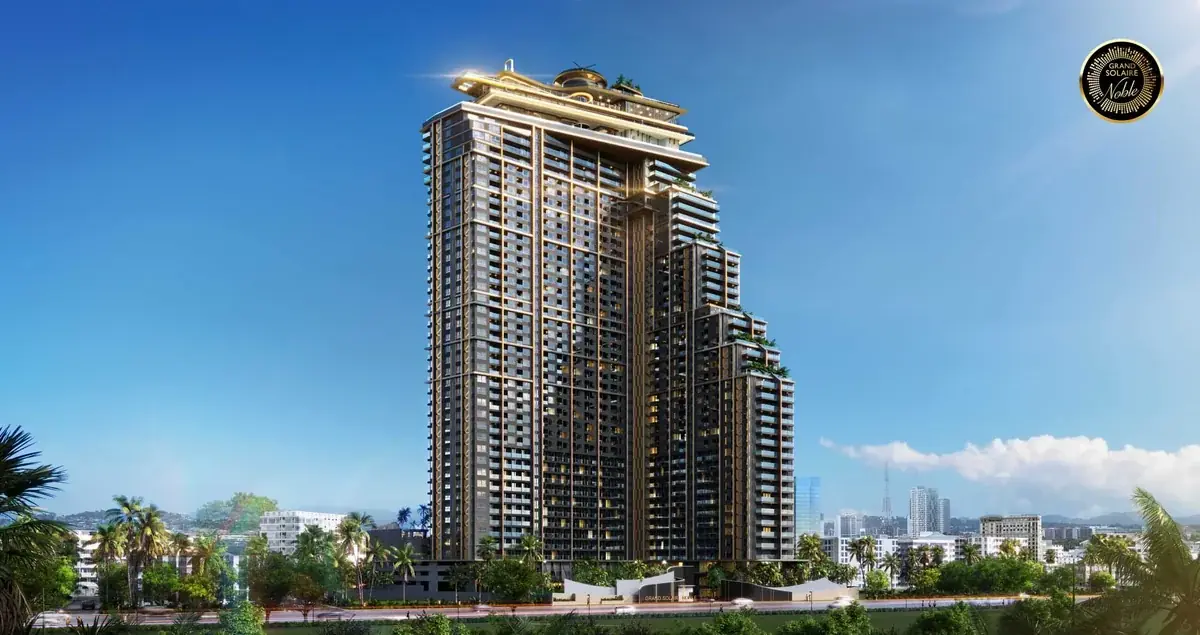
For investors who intend to invest in a high-quality Pattaya property anyway, several advantages come together in this way: low acquisition costs, low ongoing taxes, an attractive 10-year visa, and tax advantages on foreign income. Suitable investment properties include the Grand Solaire Pattaya or the Zenith Pattaya 2, which sit in the relevant price segment.

What you should do next
If you want to understand the tax side of a Pattaya investment, the most important insight has already been stated: off-plan from a vetted developer is the most tax-efficient option, and the advantage over Germany is considerable. What this means concretely in your individual case depends on the location, the investment sum, your intended use and your personal tax situation.
In my free Pattaya property guide you will find a concise overview of all aspects of buying property in Pattaya. An informal initial consultation for international buyers is free of charge. We go through your specific situation together, review suitable projects and discuss which tax conditions matter for you.
Anyone who wants to understand the concrete steps from purchase to handover will find the next practical stage in the article on the handover of keys in Pattaya.
Frequently asked questions
More on buying property in Pattaya