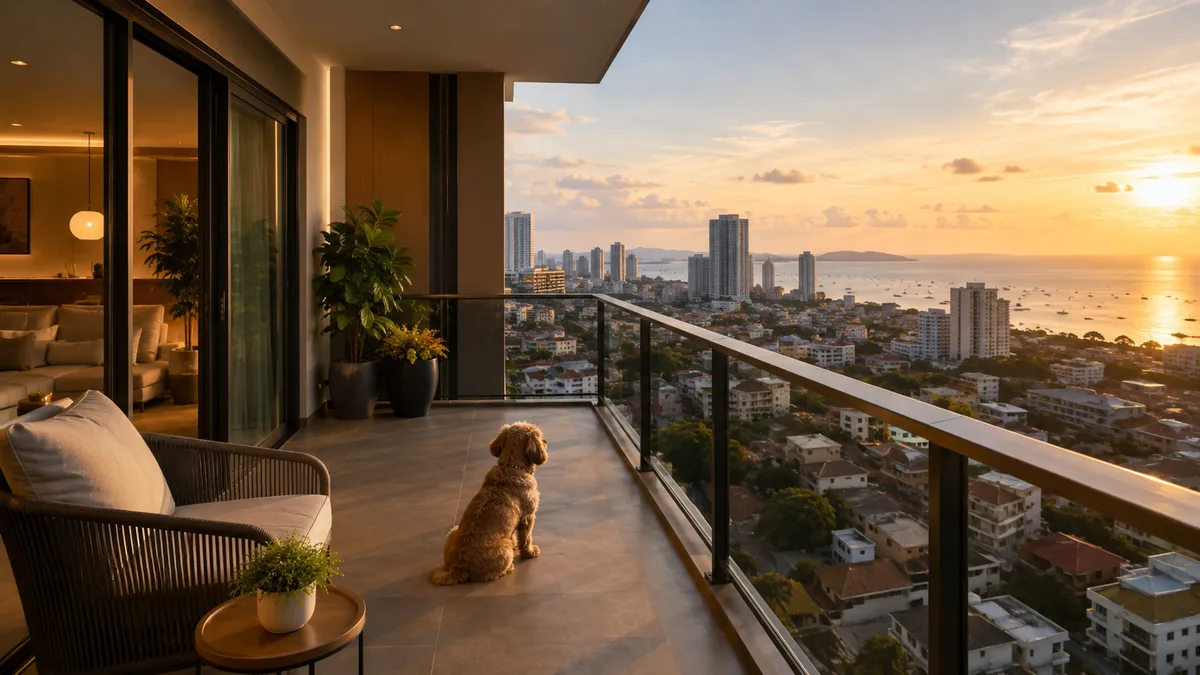
In short: Anyone moving to Pattaya with a pet can bring their dog or cat into the country completely legally and without complications – as long as the steps are followed in the right order. The key requirements are an ISO microchip, a valid rabies vaccination (administered at least 21 days before travel), an official health certificate, and the import permit from the Thai veterinary authority. There is no mandatory quarantine if the paperwork is in order. Allow around two to four months of preparation and your pet will arrive relaxed.
Moving to Pattaya with a Pet: the Overview
Thailand is pleasantly pet-friendly, and Pattaya is one of the most relaxed cities in the country for dogs and cats. Importing a pet from Germany, Austria or Switzerland is clearly regulated and very manageable – it simply requires some preparation and the correct sequence of steps. The most common mistake is not a missing document but the wrong order: if the microchip is implanted after the rabies vaccination, the vaccination is formally invalid. Anyone who works through the steps carefully will have no problems at the airport.
DACH countries are classified as states with controlled rabies status. This is a major advantage: a rabies titer test (antibody test) is generally not required for entry into Thailand. The situation is stricter in the other direction – for a later return to the EU. This is exactly the point you should factor in from the very beginning; more on that below.

The Five Building Blocks of the Import Process
For your pet to be admitted, five things must come together. They interlock and build on each other in terms of timing:
- Microchip to ISO standard 11784/11785 (15-digit), implanted before the rabies vaccination.
- Rabies vaccination, valid and administered at least 21 days and no more than 12 months before departure.
- Additional vaccinations: for dogs at minimum distemper, hepatitis, parvovirus and leptospirosis; for cats feline panleukopenia.
- Health certificate from an official veterinary authority, issued within 7 days before departure.
- Import Permit (Form R1/1) from the Thai Animal Quarantine Station, applied for 7 to 60 days before arrival.
Microchip first – the golden rule
The chip is the anchor to which all other documents are attached. It must be ISO-compliant and 15-digit. If the scanner at the airport cannot read the chip, you will need to bring your own reader. Important: the chip must have been implanted before the rabies vaccination chronologically, otherwise the vaccination will not be recognised.
Rabies vaccination and the 21-day window
After the (initial) vaccination, a waiting period of 21 days applies before travel may begin. With uninterrupted boosters this waiting period does not apply for the follow-up appointment – however, the vaccination must never be more than 12 months old. Make sure the batch number and date are clearly recorded in the vaccination booklet.
Health certificate and import permit
The health certificate (in DACH countries often the EU pet passport plus the official veterinary endorsement) must be confirmed by an official veterinarian and must not be more than 7 days old at the time of departure. You apply for the import permit in advance from the Animal Quarantine Station of the arrival airport – usually Suvarnabhumi in Bangkok. The approval is usually free of charge or involves only a small fee and is handled by email. After the on-site inspection you will receive the official R7 document, which confirms the legal entry of your pet – keep this safe.
Quarantine: Not an Issue in Practice
The most important reassurance first: with complete, correct paperwork, dogs and cats are not placed in quarantine. There is no blanket waiting period at an animal facility. The quarantine officer merely reserves the right to detain an animal for at least 30 days if documents are unclear or illness is suspected. You avoid exactly that by preparing the five building blocks properly. In practice, travel from DACH countries with proper documentation typically goes smoothly at the desk.
The IATA Carrier
On most routes from Europe, dogs and cats travel in the hold (Live Animal Cargo), which is temperature- and pressure-regulated just like the passenger cabin. Very small animals are permitted in the cabin on some airlines. An IATA-compliant carrier is mandatory. It must:
- be made of rigid material (hard plastic, fibreglass, metal or plywood),
- be large enough for the animal to stand upright, turn around and lie down naturally,
- have a leak-proof floor and a secure, lockable door (many airlines require metal fasteners),
- provide adequate ventilation on several sides.
Gradually acclimatise your pet to the carrier in the weeks beforehand – this is the single biggest contribution to a stress-free flight. Bangkok Airways charges approximately 1,000–2,500 THB depending on total weight as a rough guide; for international carriers such as Thai Airways, freight costs are based on weight and carrier dimensions.
Timeline and Costs Realistically
Allow two to four months of lead time. Engaging a specialist pet transport service provider (there are German companies that handle the complete door-to-door logistics) costs more but saves paperwork and stress. The following approximate figures help with budget planning:
| Step | Timing before departure | Approximate cost |
|---|---|---|
| Microchip implantation | before all vaccinations | €30–60 |
| Rabies vaccination | min. 21 days, max. 12 months | €30–50 |
| Additional vaccinations/check-up | ongoing | €50–120 |
| IATA carrier | buy early, acclimatise | €60–250 |
| Official health certificate | within 7 days | €50–150 |
| Import Permit (R1/1) | 7–60 days in advance | low/free |
| Air freight | on travel day | by weight/dimensions |
| Pet transport service (optional) | full handling | €1,500–4,000+ |
The range is wide because it depends heavily on the animal's size, the airline, and whether you organise everything yourself or book a service provider. As an example: small dog, self-organised, direct flight – you can often stay in the low four-figure range including the flight. Our article on cost of living in Pattaya shows how such items fit into an overall budget.
Climate: Dogs and Cats in the Tropics
Pattaya is warm and humid year-round. For pets this means: schedule walks during the cooler morning and evening hours, always carry water and avoid hot asphalt (test with the back of your hand). Air-conditioned rooms are comfortable, but avoid large temperature swings between indoors and outside. Short-nosed breeds (pug, bulldog, Persian cat) suffer more quickly in the heat – they are best brought over during the cooler season. You can read when that is in the article on climate and the best time to visit Pattaya. Veterinary care in Pattaya is excellent: there are several modern small-animal clinics, many with English-speaking staff.
Finding Pet-Friendly Condos
The often underestimated point: not every condominium allows animals. Many developments in Pattaya are explicitly pet-friendly, while others prohibit pets entirely or restrict their size and number. This is governed by the respective house rules (Condominium Regulations) and the owners' committee, not by law. Always clarify this before moving in – ideally in writing.
When buying a new-build, the pet question can be addressed and clarified from the very beginning. This is precisely where working with a local agent is an advantage: we know which projects are pet-friendly, look for ground-floor units with green areas nearby, and check the house rules for you. It is worth browsing the project overview – developments such as Arom Jomtien or Aquarous Jomtien are close to the beach with walking opportunities nearby. The neighbourhood overview compares which district suits you and your pet – quieter and greener or more central.
Buyers from abroad should also be familiar with the relevant ownership structures. We explain what matters regarding Foreign Quota, Freehold and Leasehold separately – this is just as relevant for long-term planning with a pet as choosing the right development.
Important: Plan for a Possible Return to the EU
Even if you intend to stay permanently – factor in the possibility of returning. For (re-)entry into the EU, in addition to the rabies vaccination Brussels requires a rabies titer test. And here timing is critical: after a successful blood sample, three months must pass before the animal may enter the EU. Anyone who overlooks this could find themselves stuck in an emergency. Our tip: have the titer test carried out in Germany before departure if possible and have the result documented. This protects your pet in both directions. This is not travel or legal advice – please check the current requirements with the relevant authority in good time, as rules can change.
Frequently Asked Questions about Importing a Pet to Pattaya
Do I need a rabies titer test to enter Thailand?
For animals from DACH countries (controlled rabies status) a titer test is generally not required to enter Thailand. However, Thailand reserves the right to request one in individual cases. For a later return to the EU the test is mandatory – so it is best to plan for it from the outset.
Does my dog or cat have to go into quarantine?
Not with complete and correct paperwork. There is no blanket quarantine requirement. Only if documents are unclear or illness is suspected can an animal be held for at least 30 days – with thorough preparation this is virtually impossible.
How long does the preparation take?
Realistically two to four months. The bottleneck is usually the 21-day waiting period after the rabies vaccination plus obtaining the health certificate and import permit. Anyone who wants to keep the option of returning to the EU open should start even earlier because of the three-month titer-test waiting period.
Does my pet travel in the hold or in the cabin?
On most routes from Europe in the temperature-controlled hold (Live Animal Cargo). Very small animals are permitted in the cabin on some airlines. An IATA-compliant carrier is always mandatory; check the conditions directly with your chosen airline.
Do condos in Pattaya allow pets at all?
Many do, some do not – this is governed by the individual house rules. Have the pet permission confirmed in writing before moving in or purchasing. With a new-build purchase this can be clarified in advance; we are happy to check this for you.
How to Make Your Move with a Pet a Success
With the correct sequence – chip, then vaccination, then paperwork and import permit – bringing a pet to Pattaya is entirely manageable, and your dog or cat will settle into tropical life with ease. At least as important as the bureaucracy is finding the right home: a pet-friendly condo in the right location. This is exactly where I can support you on the ground – from selecting pet-friendly developments to reviewing the house rules. Get in touch with no obligation via the contact form. And for a comprehensive overview of buying property in Pattaya, I recommend the free guide – concise, honest and tailored to buyers from DACH countries.
Free Guide
68 pages of Pattaya insider knowledge — download free