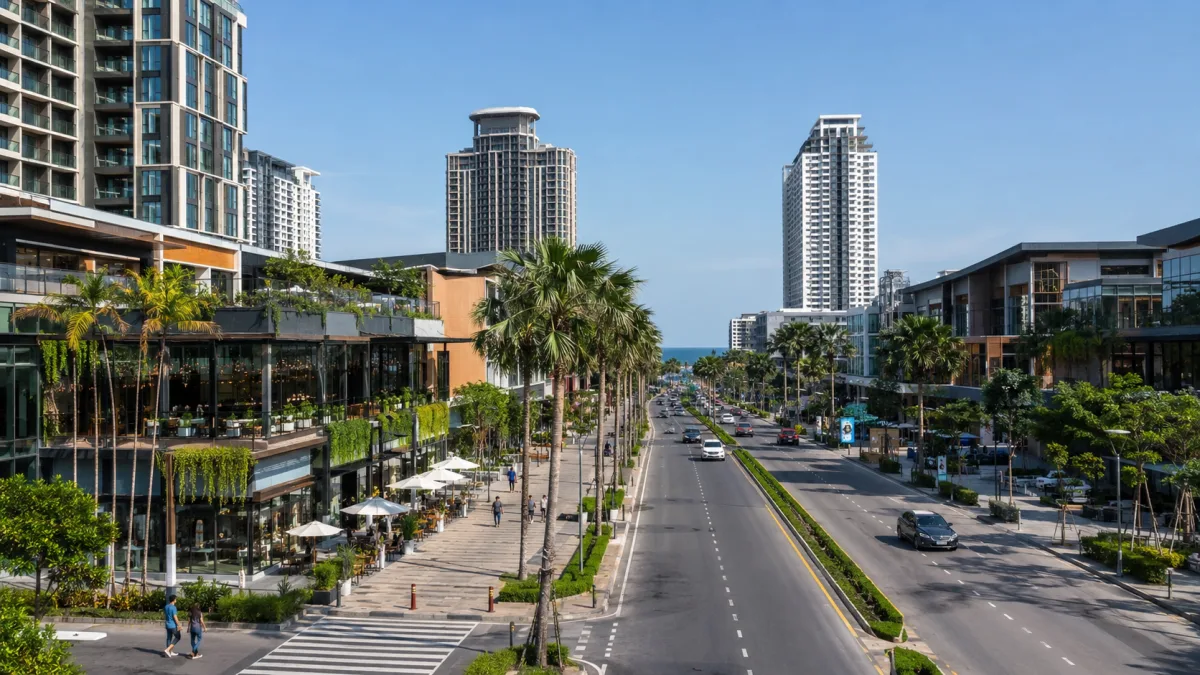
In brief: Buying a condo in Pattaya with crypto is possible in 2026 – but not by paying directly in Bitcoin or USDT. In Thailand, cryptocurrencies are a "digital asset", not legal tender; direct payment for goods has been prohibited since 2022. The clean route: you convert your coins (usually via a licensed exchange) to fiat, transfer the amount to Thailand as an international bank transfer, have it exchanged into Baht there, and receive the FET certificate – the mandatory document for the Land Department.
Buying a Condo in Pattaya with Crypto: The Legal Framework in 2026
Many DACH investors today hold part of their wealth in crypto – and regularly ask us whether it is possible to pay directly for a property in Thailand with it. The honest, well-founded answer is: crypto is an excellent means of moving capital to Thailand, but the actual purchase payment is always made in Thai Baht. This is not an obstacle; it is simply the rule of the game – and those who know it reach their goal quickly and with full legal certainty.
Thailand has regulated cryptocurrencies since 2018 via the Emergency Decree on Digital Asset Businesses. Coins such as Bitcoin (BTC) or the stablecoin Tether (USDT) are classified there as "digital assets", not legal tender. Since 1 April 2022, a regulation by the Thai securities regulator SEC has prohibited licensed crypto service providers from promoting digital assets as a direct means of payment for goods and services. The Bank of Thailand follows the same course to keep the financial system stable.
For you as a buyer, this means in practice: nobody transfers BTC or USDT directly to the developer and receives a registered apartment in return. The value of your coins is converted to money beforehand – and this step determines whether the subsequent title transfer at the Land Office proceeds smoothly.
What Has Improved in 2025/2026
The conditions have recently become noticeably more favourable for crypto-minded buyers:
- USDT and USDC officially approved: In March 2025, the SEC added the stablecoins Tether (USDT) and USD Coin (USDC) to the list of cryptocurrencies permitted for digital asset transactions – an important signal for greater legal certainty.
- Tax exemption on crypto gains: Under Ministerial Regulation No. 399 (Royal Gazette, 5 September 2025), gains from the sale of digital assets via a Thailand-licensed exchange are exempt from income tax from 1 January 2025 to 31 December 2029 – a genuine locational advantage.
- "TouristDigiPay" sandbox: Since the fourth quarter of 2025, an 18-month pilot has been running in which tourists can exchange crypto into a Baht e-wallet via regulated providers and pay by QR code. This is intended for everyday spending – not for property purchases – but it does demonstrate the country's general opening up.
Why Direct Crypto Payment for a Condo Fails – and Why That Is a Good Thing
The reason lies not in crypto regulation alone, but in property law. Foreigners may purchase condominium units in Thailand in freehold, as long as no more than 49% of the floor area in a building is in foreign hands – the so-called Foreign Quota. The key condition for this registration: the purchase funds must come to Thailand from abroad in a foreign currency (e.g. EUR, USD, CHF) and be exchanged into Baht by a Thai bank.
As proof, the bank issues the Foreign Exchange Transaction (FET) certificate. Without this document, the Land Department will not register the title under the Foreign Quota. A pure crypto transfer from wallet to wallet does not generate an FET – which is why the route necessarily passes through the conversion to fiat. Anyone who plans for this from the outset has no disadvantage whatsoever; on the contrary, the process is cleanly documented and protects your ownership.
Foreign Quota, Freehold, and the FET Proof
I have explained the details of the 49% rule and the different forms of ownership at length in the article Foreign Quota, Freehold and Leasehold for DACH Buyers. How the money reaches Thailand in a concrete and FET-compliant way is covered in the guide Money Transfer to Thailand and the FET Certificate. Both texts are the ideal complement to this article.
An important note on the threshold: for transfers equivalent to approximately 50,000 USD or more, the bank issues the standard FET form. For smaller amounts, a so-called "Credit Note" from the bank is sufficient; it serves the same purpose and is accepted at the Land Office.
How the Crypto Purchase Works in Practice – Step by Step
In practice, a clear process has proven itself. Which of the two routes is right for you depends on where you are tax-resident and where your coins are held.
Route A: Converting in Your Home Country (the Simplest Option for Many DACH Buyers)
- You sell BTC/USDT via your regular, regulated exchange in Germany, Austria, or Switzerland and receive EUR/CHF into your bank account.
- You transfer the purchase amount in that foreign currency from your home account to Thailand – with the payment reference "Purchase of condominium".
- The Thai bank converts to Baht and issues the FET certificate (or Credit Note).
- With the FET, sales contract with the developer, and passport, the title transfer takes place at the Land Office.
This route is transparent, clearly documented for tax purposes in DACH countries, and avoids any grey area. The coins become money before they reach Thailand.
Route B: Converting via a Thai Licensed Exchange
Those already living in Thailand or wishing to take advantage of the tax exemption on crypto gains can sell coins via a Thailand-licensed exchange (such as Bitkub). Note: for Foreign Quota registration, the funds must still be documented as an overseas transfer. In practice, this often means that foreign currency must first flow into Thailand from abroad; a purely domestic crypto realisation does not generate an FET. A clean structure is critical here – and this is exactly where I support you, working with specialist law firms and tax advisers as needed.
| Step | What Happens | Result |
|---|---|---|
| 1. Sell coins | Exchange BTC/USDT to fiat via regulated exchange | EUR/USD/CHF in bank account |
| 2. International transfer | Send foreign currency to Thailand | Funds received at Thai bank |
| 3. Convert to Baht | Thai bank exchanges to THB | FET certificate / Credit Note |
| 4. Registration | Handover at the Land Office | Title in Foreign Quota |
Opportunities and Limitations for DACH Investors
The crypto route offers tangible advantages – above all speed and flexibility in moving capital. At the same time, there are clear limitations that you should be aware of.
- Opportunity – Speed: Crypto moves capital across borders within minutes. Especially in the early construction phase, when a reservation counts, this is a real plus.
- Opportunity – Tax window: Until end of 2029, gains from sales via a Thai licensed exchange are income-tax-free. Interesting for those resident in Thailand – DACH taxation on the sale remains unaffected.
- Limitation – Volatility: Between reservation and conversion, the exchange rate can fluctuate. Stablecoins such as USDT reduce this risk but are no substitute for proper planning.
- Limitation – No FET without foreign fiat: For the Foreign Quota, there is no way around the documented overseas transfer in foreign currency.
- Limitation – Developer practice: Not every developer accepts crypto; settlement is generally made in Baht in any case. For my vetted new-build projects, I clarify the payment terms for you in advance.
How the purchase price can be spread across a payment plan – which combines well with staggered crypto sales – is covered in the article Financing a Condo in Pattaya and Payment Plans.
Price Guide: What Does a Condo in Pattaya Cost in 2026?
To give you a rough idea of the crypto amount required, here are reliable reference figures (off-plan/new-build, THB per m²). These are indicative values, not fixed prices:
| Location | Price per m² (THB) | Typical total price (approx.) |
|---|---|---|
| Jomtien | 125,000–220,000 | 1-BR approx. 120,000–170,000 € |
| Central Pattaya | 130,000–250,000 | Studio from approx. 100,000 € |
| Pratumnak Hill | 120,000–200,000 | 2-BR approx. 180,000–250,000 € |
| Wongamat/Naklua | 115,000–260,000 (peak 300,000+) | depending on sea view |
For conversion I calculate conservatively at approximately 38–39 THB per euro. My own projects such as Grand Solaire Noble (142,000–219,000 THB/m²) or Aquarous Jomtien in the Foreign Quota (138,000–217,000 THB/m²) sit squarely within this range. I go into greater depth in the Pattaya Off-Plan Price Report 2026 and in the foundational article What Does a Condo in Pattaya Really Cost?
Off-Plan: The Price Advantage as Capital Appreciation
In the early construction phase, units can be up to 40% cheaper than at completion. This is a capital appreciation effect – not to be confused with ongoing market price growth of around 3–5% p.a., nor with rental yields of approximately 5–8% p.a. (gross). Why off-plan is particularly attractive for crypto buyers is covered in Buying Off-Plan in Pattaya; I address the yield question honestly in Rental Yield Realistically Explained.
Taxes and Documentation – Clean from the Start
With a crypto purchase, a complete paper trail of the money matters. Document the sale of the coins, the international transfer, and the FET certificate. This allows you to clearly demonstrate the source of funds to banks and authorities – which is in line with KYC/AML requirements and protects you. Thai purchase transaction costs for new-builds are, incidentally, low; details are in the article Taxes on a Condo Purchase in Pattaya and running costs under Running Costs: Common Area Fee and Sinking Fund.
Important: this is not tax or investment advice. The tax treatment of your crypto gains in Germany, Austria, or Switzerland depends on your individual circumstances – you should involve a tax adviser for this.
Frequently Asked Questions About Buying a Condo in Pattaya with Crypto
Can I pay for a condo in Pattaya directly with Bitcoin or USDT?
No. Crypto is classified in Thailand as a digital asset, not a means of payment; direct payment for goods has been prohibited since 2022. You convert your coins to fiat first, transfer the amount to Thailand, and have it exchanged into Baht there.
Do I still need an FET certificate when using the crypto route?
Yes. For registration under foreign freehold ownership (Foreign Quota), the Land Department requires proof that the funds arrived from abroad in a foreign currency and were exchanged into Baht. This proof is the FET certificate (or, for smaller amounts, a Credit Note from the bank).
Is it worth going via a Thai crypto exchange for the tax exemption?
For residents in Thailand, the exemption on gains (valid 2025–2029, sold via a licensed exchange) can be attractive. For Foreign Quota registration, the purchase funds must still be documented as an overseas transfer. The structure should be clarified in advance with a tax adviser.
Is USDT or Bitcoin better suited for the transfer?
USDT as a stablecoin reduces exchange-rate risk between sale and conversion and has been expressly approved in Thailand since 2025. Bitcoin works equally well but fluctuates more. What matters in the end is the clean conversion to fiat and the FET.
Do your new-build projects accept crypto directly?
Payment is normally settled in Baht. Whether a developer accepts a crypto-adjacent process is something I clarify in advance on a project-by-project basis for you – so that reservation, payment plan, and FET proof fit together from the start.
Are you considering directing your crypto gains into a new-build condo in Pattaya? I guide you from project selection through FET-compliant money transfer to title transfer – on the ground since 2018. Contact me without obligation via the contact form or download my free guide with all the steps to a secure condo purchase first. An overview of current projects can be found under Project Overview.
Free Guide
68 pages of Pattaya insider knowledge — download free