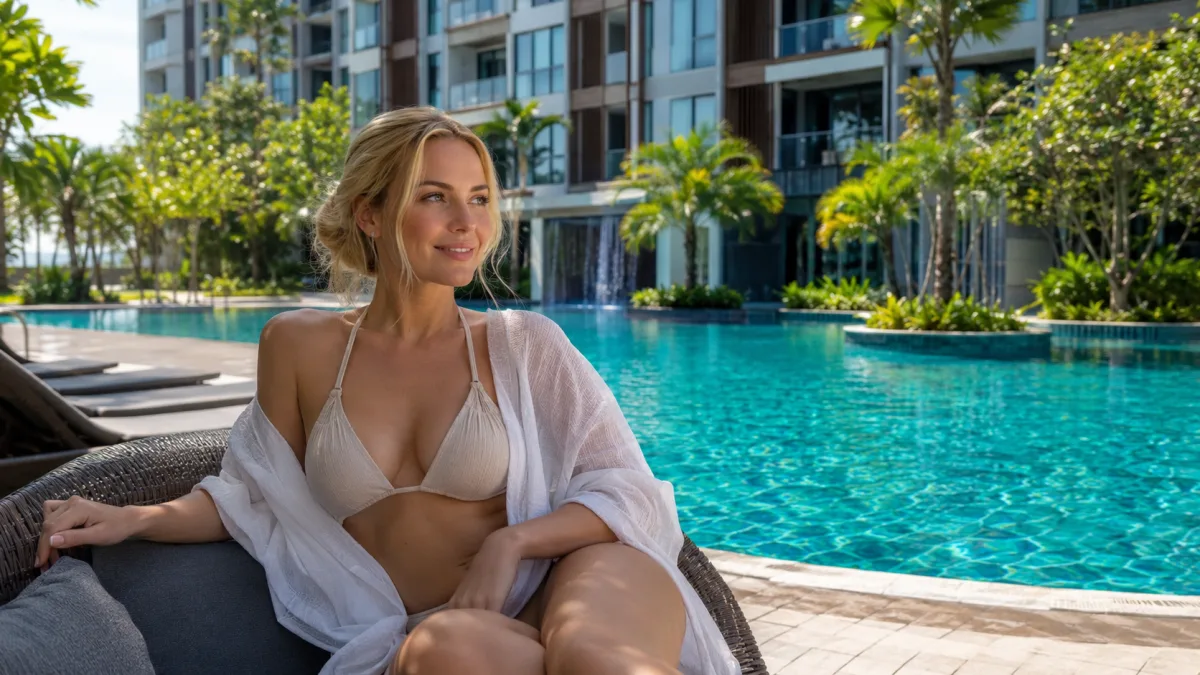
In short: Whether a low-rise or high-rise in Pattaya suits you better depends on your goal. Low-rise condos (usually up to 8 storeys, under 23 m) score with privacy, fewer units and lower ongoing costs. High-rise projects offer sea views, rooftop pool terraces and extensive facilities — ideal for rentals and resale. Both can be worthwhile; what matters is location, developer and your intended use.
Low-Rise or High-Rise in Pattaya: What the Difference Really Means
In Pattaya you encounter two basic types of new-build condos. The term "high-rise" is not just marketing: under Thailand's Building Control Act, a building is legally classified as a "High Building" from a height of 23 metres — roughly from the 8th or 9th floor upwards. Everything below that is colloquially referred to as low-rise, typically four to eight storeys. This 23-metre threshold is more than just a number: beyond it, stricter building regulations apply regarding fire safety, lifts, escape routes and structural engineering, which affects build quality, fittings and ultimately ongoing costs.
For buyers from German-speaking countries, this means: both types have clear strengths. There is no "better" or "worse" — only "suits my plan" or doesn't. This is precisely where I come in as your agent on the ground: I know the individual projects, the developers and their track records, and I assess which type fits your intended use.

Low-Rise Condos in Pattaya: Privacy and Tranquillity
Low-rise projects in Pattaya have gained noticeably in popularity over recent years — particularly among buyers who plan to live there themselves or are looking for a quiet second residence. The appeal lies in their manageable scale.
The Advantages at a Glance
- Fewer units: A typical low-rise project has 30 to 120 apartments rather than the 400 to 1,000 of a large tower. That means less hustle and bustle, shorter waits at the pool and lift, and an almost neighbourhood-like atmosphere.
- More privacy: Less through traffic in the building, often more generous floor plans and quieter locations away from the main roads.
- Lower ongoing costs: Without the complex technology of a high-rise building (multiple high-speed lifts, a large lobby, extensive fire-safety systems), the common area fee tends to be lower.
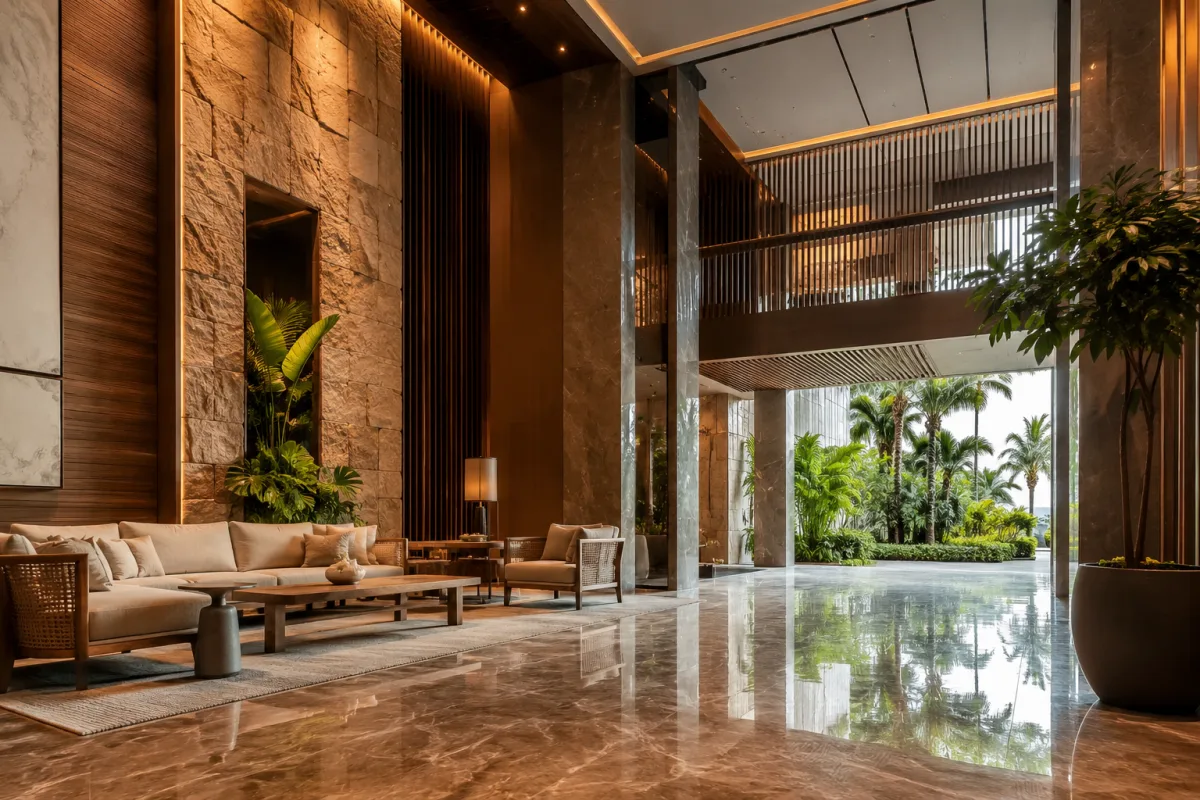
- Boutique character: Many low-rise projects emphasise design, landscaped gardens and a quiet residential quality — a profile that attracts well-maintained long-term tenants and residents.
What to Watch Out For
Low-rise rarely means "sea view from the 30th floor." Anyone wanting a sweeping view of the Gulf is usually looking in the wrong place here. The range of facilities is also often leaner — one pool and a small gym rather than a sky lounge, co-working space and multiple pools. For short-term holiday rentals this is a factor, as many tourists specifically look for these extras. Charming low-rise developments can be found, among other places, in the quieter areas of Pratumnak Hill and parts of Na Jomtien.
High-Rise Condos in Pattaya: Sea Views and Facilities
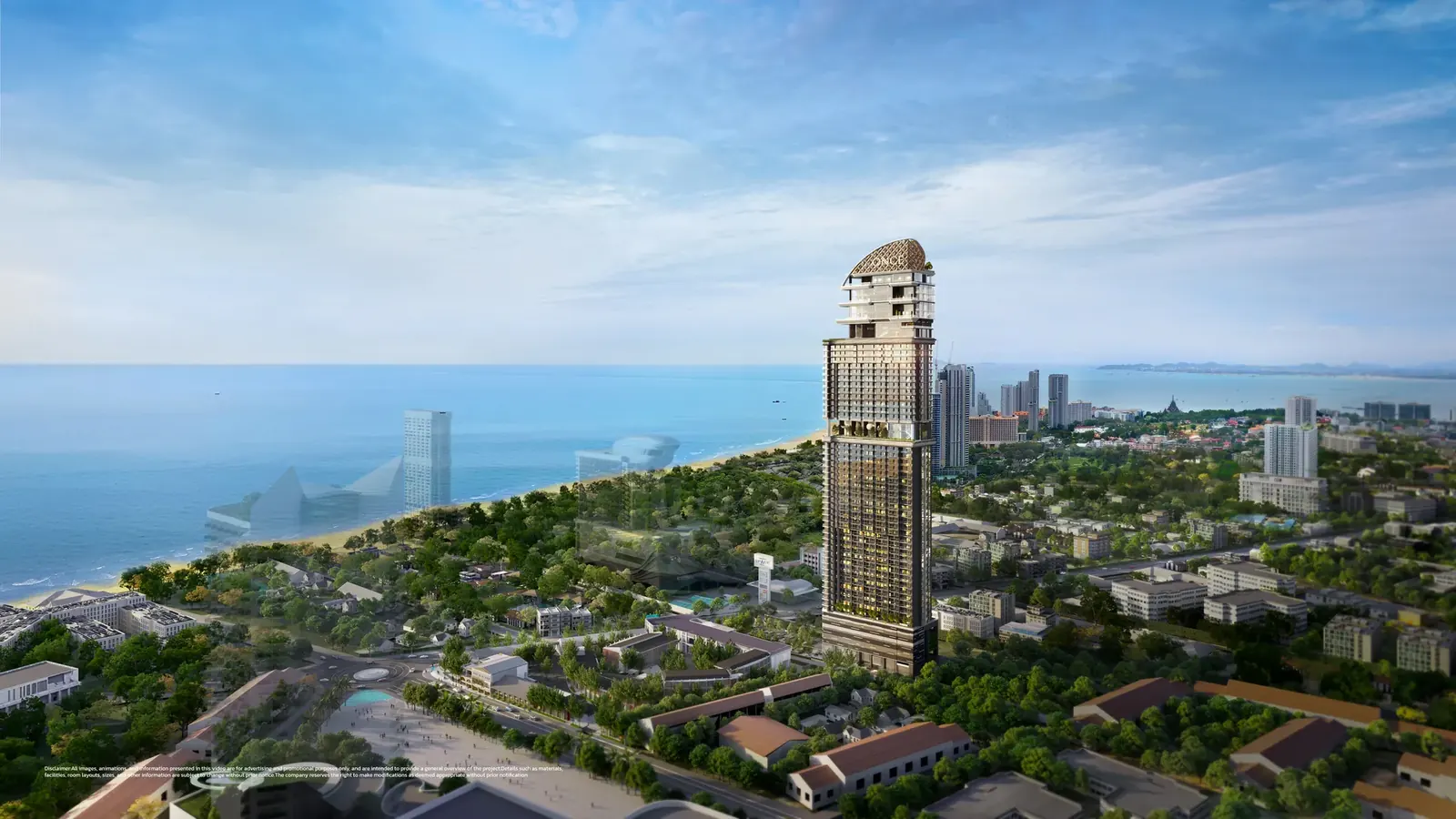
High-rise towers define the skyline of Central Pattaya, Jomtien and Wongamat. They are what many people picture first when they think of a condo in Thailand — and for good reason.
The Advantages at a Glance
- Sea views: The strongest selling point. Units from the upper floors offer the coveted view over the Gulf of Thailand — a feature that significantly raises rental prices and resale value.
- Extensive facilities: Infinity pools on the roof, sky lounges, multiple fitness areas, saunas, co-working spaces, and sometimes cinemas and gardens. This experience is exactly what sells in holiday rentals.
- Prime locations: Large towers are often situated at the best addresses directly on or near the beach, where land is scarce.
- Visibility and liquidity: Well-known high-rise projects are easier to trade on the market — many prospective buyers already know them, which makes resale smoother.
What to Watch Out For
More technology means more maintenance. Lifts, pumps for supplying water to great heights, extensive fire-safety systems and large communal areas are all reflected in the common area fee. In addition, quality in large towers varies considerably depending on the developer and the subsequent management. Knowing which projects are reliably built and well managed is exactly my job — that's why I'm here on the ground. One example of a well-conceived high-rise project with sea views is the SkyPark Lucean in Jomtien.
Direct Cost Comparison: CAM, Sinking Fund and Lifts
Ongoing costs are the most common point of difference between low-rise and high-rise. Two items are central: the monthly Common Area Fee (CAM) for day-to-day operations, and the one-off Sinking Fund (maintenance reserve) due at handover.
| Feature | Low-Rise (up to ~8 storeys) | High-Rise (tower, 20+ storeys) |
|---|---|---|
| Typical units | 30–120 | 300–1,000+ |
| Common Area Fee | approx. 40–55 THB/m²/month | approx. 50–70 THB/m²/month |
| Sinking Fund (one-off) | approx. 450–500 THB/m² | approx. 500–600 THB/m² |
| Lifts | often 1, sometimes none | multiple high-speed lifts |
| Facilities | lean (pool, gym) | extensive (sky pool, lounge, co-working) |
| Sea view | rarely / selected locations only | standard from upper floors |
| Privacy | high | medium |
A worked example: for a 35 m² unit, a CAM of 50 THB/m² amounts to around 1,750 THB per month — approximately €45. In a tower at 65 THB/m² it comes to around 2,275 THB, or roughly €58. The difference seems small but adds up over the years. Importantly, a higher CAM is not automatically "expensive in a negative sense" — it funds the facilities that make your unit attractive to tenants and buyers. A detailed breakdown of these items can be found in my article on ongoing costs of a condo in Pattaya.
Rentals: Which Type Delivers the Better Yield?
Both types achieve the typical gross rental yield of around 5–8% p.a. in good locations — neither "wins" across the board. What matters is which type suits your rental strategy.
- Short-term holiday rental: This is where the high-rise plays to its strengths. Tourists pay for sea views, rooftop pools and location. Units with sea views or on higher floors typically achieve around 15–25% higher rental prices than comparable units without a view.
- Long-term rental: Long-term tenants — such as expats or residents seeking peace and quiet — often place more value on tranquillity, privacy and low utility costs. Here, a well-maintained low-rise is frequently in high demand and delivers stable, predictable income.
An honest calculation matters: the higher gross rent in a tower is partly offset by the higher CAM and higher purchase price, so the net yield of both types is often closer together than it initially appears. How to calculate realistically is explained in my article Rental Yield Explained Realistically. This is explicitly not investment advice — all figures are indicative.
Capital Growth and Resale
At resale, location is paramount — and high-rise towers often have the edge here because they occupy prime addresses directly on the waterfront, where buildable land is scarce. A sea view remains a lasting argument that tends to become more valuable over the years as further construction surrounds the building and unobstructed view corridors become rarer.
Low-rise projects gain value where peace and privacy are scarce — for example in sought-after, densely built-up districts where a boutique building fills a niche. For both types, a general market price trend of around 3–5% p.a. capital appreciation applies, with new-build carrying a premium of around 20% over older resale stock.
The biggest lever remains buying early: purchasing off-plan in an early construction phase can mean paying up to 40% less than at completion. This capital gain applies equally to low-rise and high-rise — more on this in my guide Buying Off-Plan in Pattaya and in the current Price Report 2026.
Which Type Suits Which Buyer?
As a rule of thumb from my practice:
- You want to live there yourself, value peace and quiet and low service charges? Then it is worth taking a close look at quality low-rise projects, for example on Pratumnak Hill or in Na Jomtien.
- Your primary goal is renting to tourists and maximising sea views? Then a well-located high-rise in Central Pattaya, Jomtien or Wongamat is usually the stronger choice.
- You want a mix of personal use and rental? Then it comes down to the specific project — and this is exactly where I help you find the right one.
I compare which district suits which profile in detail in my article on Pattaya neighbourhoods. An overview of my current new-build projects — from low-rise to high-rise — can be found under Projects.
Frequently Asked Questions about Low-Rise and High-Rise in Pattaya
From what point is a condo in Pattaya considered a high-rise?
Under Thailand's Building Control Act, a building is legally classified as a "High Building" from a height of 23 metres — roughly from the 8th or 9th floor upwards. Below that, buildings are colloquially called low-rise. Beyond this threshold, stricter regulations apply for lifts, fire safety and structural engineering.
Are the ongoing costs in a high-rise really higher?
Generally yes. The common area fee in a tower is often around 50–70 THB/m² per month compared with around 40–55 THB/m² in a low-rise, because lifts, water pumps and extensive facilities require more upkeep. That said, this fee also funds exactly the amenities that boost rental value.
Can foreigners own property in both types (Foreign Quota)?
Yes. The Foreign Quota rule (up to 49% of the total floor area of a condominium may be sold to foreigners as freehold) applies equally to low-rise and high-rise. I explain the details in the article on Foreign Quota, Freehold and Leasehold.
Which is better for holiday rental?
For classic short-term rentals to tourists, the high-rise with sea views and a rooftop pool usually has the edge, because those extras are precisely what gets booked. For stable long-term rentals to residents, a quiet, well-maintained low-rise is often ideal.
Is the premium for a sea-view unit worth it?
In many cases yes, especially for rentals and resale: sea-view units typically achieve 15–25% higher rents and remain in demand over the long term. Whether the premium makes sense for your specific goal is best worked out together — this is not investment advice, but an honest assessment based on indicative figures.
Not sure which type fits your plan? I know the projects, the developers and the locations in Pattaya first-hand and will help you find the right unit — no risk talk, just clear numbers. Contact me without obligation via the contact form. And download my free guide in advance — in it I explain step by step what really matters when buying a condo in Pattaya.
Free Guide
68 pages of Pattaya insider knowledge — download free