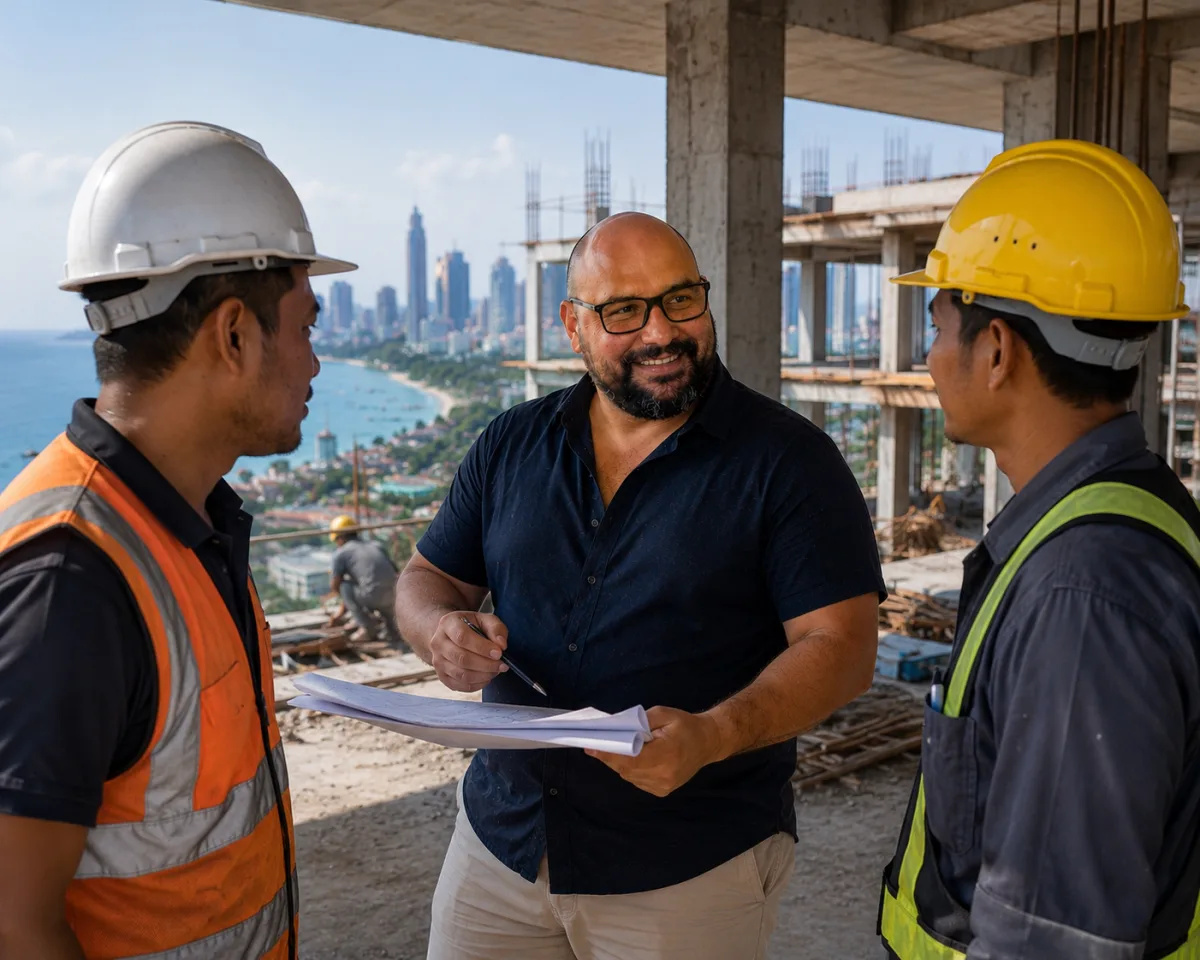
In short: May 2026 is a favourable time to buy off-plan in Pattaya: the OCPB buyer protection (in force since January 2025), rising construction costs and attractive developer terms all come together at once. An average apartment costs around 3.6 million baht (approx. EUR 98,000), and prices are likely to rise by 2-7% in 2026. Off-plan buyers pay only around 1% in purchase costs, benefit from staggered instalments over 2-4 years and 10-25% capital-growth potential by completion; rental yields sit at roughly 5-8%.
Anyone looking for a property in Pattaya in 2026 will find a market situation that creates unusually favourable conditions for well-prepared international buyers. Three developments converge in May 2026: a new statutory buyer protection that many prospective buyers are not yet aware of, increased construction costs that will drive up future project prices, and developers who, in the current market environment, are working with more attractive terms than they were two years ago. Anyone entering off-plan now benefits from a constellation that, in all likelihood, will not last long.
In this article I analyse the current market situation based on the latest data from CBRE Thailand, Knight Frank, REIC and independent market reports. Honestly, with figures, and with concrete conclusions for international buyers focused on investment or personal use. First, some background: I have been a real-estate agent in Pattaya for eight years, with fifteen years of Asia experience before that, and my work focuses predominantly on off-plan investments with reputable, licensed developers. For good reason, as will quickly become clear.
Free Guide
68 pages of Pattaya insider knowledge, download for free
Why May 2026 is a special moment in the market for off-plan
Three developments come together simultaneously in Pattaya in May 2026, and their combination creates an unusually favourable situation for off-plan buyers.
First, a new statutory buyer protection has been in place since January 2025, enacted by the Office of Consumer Protection Board, OCPB for short. This regulation protects off-plan buyers in Thailand considerably better against risks during the construction process than ever before. Anyone buying off-plan in 2026 buys with a level of consumer protection that can genuinely hold its own against European markets.
Second, raw-material and construction costs in Thailand rose significantly in 2025 and early 2026. Developers will gradually factor these cost increases into the prices of new project launches. Anyone entering an already-planned or currently-launching project today still secures the prices in place before the next round of adjustments. In six to twelve months, the entry-price level for new off-plan projects will be noticeably higher.
Third, developers are working with more attractive terms in the current market environment. Longer payment plans, staggered down-payments, occasionally furniture packages or preferential unit selection. Developers know that international buyers in the premium off-plan segment have more choice today than they did just a few years ago, and they are investing more attention in the sales process accordingly.
Anyone entering off-plan now benefits from a constellation that, in all likelihood, will not last long.
, Alexander ReifenschneiderThree developments, one clear picture: for off-plan buyers, May 2026 is one of the more interesting moments to enter the market in recent years.
The market in detail: what the figures really show
The average apartment in Pattaya costs around 3.6 million baht in 2026, which converts to roughly EUR 98,000. The median sits at 3.2 million baht, or around EUR 87,000. About eighty percent of all apartments on the market fall within a price range of between 1.6 and 6 million baht, that is, between EUR 44,000 and EUR 164,000. These figures come from the current CBRE Thailand market report and were cross-checked against REIC data for Chonburi.
Price development in Pattaya in 2026 is moderate and healthy. Unlike in the booming pre-pandemic years, today's increases are grounded in fundamentals rather than speculation. CBRE and Knight Frank forecast moderate growth of between two and seven percent for 2026, depending on location and segment. Premium locations such as Wongamat or Pratumnak are developing more strongly than the mid-tier locations. Pattaya is thus entering a phase that international market observers describe as „stable, selective, opportunity-driven“.
It is important to understand the underlying dynamic in new-build prices: raw-material costs rose noticeably in 2025 and early 2026. Steel, cement, glass, aluminium profiles and sanitary components have all become significantly more expensive, often by double-digit percentages. Developers cannot absorb these cost increases indefinitely. Anyone entering today on still-favourable terms in an ongoing or just-launching off-plan project benefits from price levels that will no longer be available in subsequent sales phases, or in the next projects from the same developers.
The resale market shows mixed signals. Listing prices are typically seven percent above actual sale prices, which opens up room for negotiation for cash buyers who want a property for their own use. For international buyers with an investment focus, however, the off-plan route remains the considerably better choice for several structural reasons, as I will show in a moment.
OCPB buyer protection since 2025: off-plan has never been safer
Here comes the most important regulatory change, one that many international buyers are not yet aware of. Since January 2025, new regulations from the Office of Consumer Protection Board have applied to off-plan purchases in Thailand. The core idea: buyers who make a down-payment on an apartment under construction are considerably better protected against risk should the developer fail to meet its contractual obligations.
In concrete terms, this means: if a buyer has to withdraw from the purchase for legitimate reasons, for example because the developer significantly delays the promised completion date or fails to meet agreed quality standards, the legal hurdles for recovering the down-payment are considerably lower than they were before 2025. This regulation has noticeably increased the appeal of off-plan purchases in Thailand.
The OCPB rules apply in addition to the existing consumer-protection mechanisms of the Condominium Act. In combination, the result is a level of protection that can genuinely hold its own against off-plan purchases in European markets. The condition, however, is that the buyer works with a licensed and reputable developer. With unknown players or dubious structures, even the best laws are of little help.
In day-to-day sales, we clearly notice the effects of the OCPB rules. Prospective buyers who used to hesitate now make decisions more quickly because legal certainty has increased. Developers, for their part, work more transparently because the consequences of contractual default have become more costly. A development that serves everyone involved. Anyone wishing to deepen their understanding of the fundamentals of off-plan buying will find them in my detailed article Off-Plan in Pattaya 2026: Opportunities, Risks and What Really Matters.
Off-plan in Pattaya: the key advantages in the current market
Buying off-plan from a reputable developer is the strategically and economically superior choice for international buyers in 2026. The reasons are clearly demonstrable.
Advantage 1: Lowest purchase costs. When buying off-plan from a licensed developer, the buyer pays at the Land Office, by law, at most half of the 2% transfer fee, that is, around 1% of the purchase price. Specific Business Tax, Stamp Duty and Withholding Tax are entirely the developer's responsibility. This means the buyer's share is dramatically lower than for a purchase in Germany, where purchase costs run between 8 and 15 percent. You will find the detailed comparison in my article on the taxes and incidental costs of buying a condo in Pattaya in 2026.
Advantage 2: Attractive payment plans. Off-plan purchases in Thailand typically run with a down-payment of 25 to 40 percent and a staggered balance paid over the construction phase. Anyone investing EUR 130,000 does not have to put that sum on the table all at once, but spreads it over two to four years. This considerably improves capital commitment and personal liquidity planning.
Advantage 3: The latest building fabric and fittings. A completed apartment from a 2026 project meets current standards in terms of materials, smart-home integration, energy efficiency and communal areas. Resale apartments from older construction phases are often technically at the standard of their respective build period.
Advantage 4: OCPB buyer protection since January 2025. As described above: off-plan is today better protected in legal terms than ever before.
Advantage 5: Maximum return potential over the construction phase. Anyone entering during the early marketing phase secures units on terms that are no longer available after completion. Capital growth of 10 to 25 percent between off-plan entry and handover is realistically achievable with good projects in attractive locations.
- Lowest purchase costs: around 1% instead of 8 to 15% as in Germany
- Attractive payment plans: 25 to 40% down-payment, the rest staggered over 2 to 4 years
- The latest building fabric, materials, smart-home integration, energy efficiency
- OCPB buyer protection since January 2025, on a par with European markets
- 10 to 25% capital-growth potential between off-plan entry and handover
What about resale? Resale purchases can make sense in special cases, for example for buyers who need to move in immediately or for outright cash buyers with extensive negotiating experience. For the typical international investment or own-use scenario, however, they remain clearly inferior, above all because of the higher purchase costs (3 to 5 percent instead of 1 percent), the full capital due immediately, and the older building fabric.
Current off-plan projects with an excellent developer track record include, for example, the Grand Solaire Pattaya, the Zenith Pattaya 2 and the Copacabana Coral Reef. Each of these projects has its own positioning in terms of location, price segment and buyer profile. Which choice specifically suits you is best clarified in a personal conversation.
Rental yield Pattaya 2026: where investments have the greatest leverage
The most important metric for investment buyers is the rental yield. In Pattaya in 2026, clear location clusters can be identified.
Central Pattaya offers the highest yields for well-positioned apartments. Locations around Beach Road, close to the central shopping centres and within a short distance of Pattaya's signature lifestyle areas achieve gross yields of seven to ten percent. For investors with a pure yield objective and no desire for personal use, Central Pattaya remains an attractive location.
Jomtien and Na Jomtien deliver stable yields in the range of six to eight percent. These locations are quieter than Central, with good beach proximity and growing infrastructure. Families and long-term tenants favour these areas, which increases letting security. Top projects with good fittings also reach seven percent and more here.
Pratumnak, as a premium hilltop location, delivers yields of six to eight percent, combined with strong value retention and rising per-square-metre prices. Pratumnak is regarded as one of the locations where value development is likely to be above average in the coming years.
Wongamat is the location with the highest premium positioning. Anyone buying here is not primarily buying for maximum yield, but for long-term value retention and exclusive personal use. Gross yields typically sit at five to seven percent, with unusually high value retention even in difficult market phases.
What is clearly emerging in 2026: the quality of long-term tenants is rising. More location-independent professionals, more international long-term residents, more families with children at international schools. This makes the rental market more stable than it was just a few years ago, when Pattaya was heavily dependent on day tourism.
Capital transfer and exchange rate: what international buyers should consider now
An often-underestimated aspect: Thai regulations require that the entire purchase price be transferred from abroad, demonstrably, in Thai baht or an accepted foreign currency. This transfer is documented with the so-called FET certificate, which is later a prerequisite for registration at the Land Office. You will find more on the practical steps in my article Handover in Pattaya: The Practical Guide for International Buyers.
A clear advantage of off-plan in this context: you do not transfer the entire purchase price at once, but in several tranches in line with the payment plan. The down-payment, construction-phase instalments and final instalment are spread over the construction phase. This gives you the flexibility to use exchange rates strategically and to avoid exposing your capital to a single day's rate in one transfer.
An additional complexity arises from the tightened international compliance requirements of some European banks in 2026. Some international clients report additional queries from their home bank for larger transfers to Thailand. This is no cause for alarm, but it does require lead time. Anyone transferring the purchase price only two weeks before the Land Office appointment can come under pressure should the bank raise questions. Four to six weeks' lead time is safe. With off-plan tranches, this lead time is easy to manage.

Strategy: how I advise international buyers in May 2026
The honest answer to the most common question I am hearing at the moment is: yes, May 2026 really is an interesting moment in the market for well-prepared international buyers, above all for off-plan investments with licensed developers. But this only holds under certain conditions.
Who can benefit now: international buyers with a clear strategy, sufficient liquidity for at least five to ten years of commitment, realistic return expectations and the willingness to assess the market properly with professional guidance. Anyone planning an off-plan purchase with a vetted developer buys today with better buyer protection, the lowest purchase costs, and ahead of the next price wave.
Who should still wait: buyers with an uncertain life situation, without sufficient liquidity reserves, with expectations of a quick return of capital within one to two years. Pattaya is a five-to-ten-year investment, not a trading asset. Anyone who cannot accept this should postpone the purchase. More on this in my article When Pattaya as a Property Location Does Not Suit You.
Anyone planning to live in Pattaya permanently: should additionally look into the Long-Term Resident Visa, which grants high-net-worth buyers a residence permit of 10 years plus tax advantages on foreign income. Details in my article Visa and Residence 2026 for International Property Buyers.
In my free Pattaya Property Guide you will find a concise overview of all the key aspects of buying a property in Pattaya. An initial consultation with no obligation for international buyers is free of charge. Together we go through your specific situation, review suitable off-plan projects and discuss which options in the current market best suit you.
Frequently asked questions
More on buying property in Pattaya