In short: Buying a condo in Thailand does not require any special visa, ownership and the right of residence are regulated separately. For occasional users, the free visa-exempt entry for 60 days (plus a 30-day extension) is enough in 2026. Anyone staying longer chooses the DTV visa (5 years, around 350 euros, proof of 500,000 baht in funds), the O-A retirement visa from age 50 (65,000 baht monthly income or 800,000 baht fixed deposit), or the 10-year LTR visa (50,000 baht), here, your Pattaya property counts directly towards the required 500,000 US dollars in Thai investment.
Anyone who buys a property in Pattaya sooner or later starts thinking about their own residency status. How long am I allowed to stay in my condo? Do I need a particular visa in order to buy the apartment? What options are really available in 2026, and which one suits my situation in life? These questions come up in almost every initial consultation.
In this article I go through the most important visa routes that are relevant today for international buyers. Honestly, with the real 2026 figures, and with clear recommendations on which visa suits which profile. One important note right at the start: I am a property agent, not a visa lawyer. What you read here is a well-founded overview drawn from my daily work with buyers, but it does not replace individual advice from a specialised visa service provider or the official information from the Thai authorities.
Free Guide
68 pages of Pattaya insider knowledge, download for free
Why a visa and buying property are two separate matters
First, one of the most common misunderstandings: buying a condo in Thailand does not require any particular visa. You can acquire a freehold apartment in Thailand as a tourist, under the visa exemption, on a long-term visa, or without any residence permit at all. The prerequisites are the correct transfer of the purchase price from abroad and compliance with the foreign quota in the relevant building. You can find more on the legal fundamentals in my article on off-plan in Pattaya 2026.
The question of a visa only arises once you also want to use the apartment yourself. Anyone who spends two weeks a year on holiday in their own condo will manage with the simple visa exemption. Anyone planning to live in Pattaya for several months a year, or permanently, needs an appropriate basis for residence. That is precisely what this article is about.
The visa exemption: 60 days for the first visit
German, Austrian and Swiss citizens receive a visa exemption of 60 days on entry to Thailand. This rule was extended from the previous 30 days to 60 days in the summer of 2024 and continues to apply in 2026. It is free of charge, requires no application in advance, and applies both on entry by air and overland.
Important to know: since May 2025, the Thailand Digital Arrival Card, or TDAC for short, has been mandatory. It replaces the former paper form TM6 and must be completed online at tdac.immigration.go.th at the latest three days before arrival. The TDAC is free, takes a few minutes, and without it you may run into problems on entry.
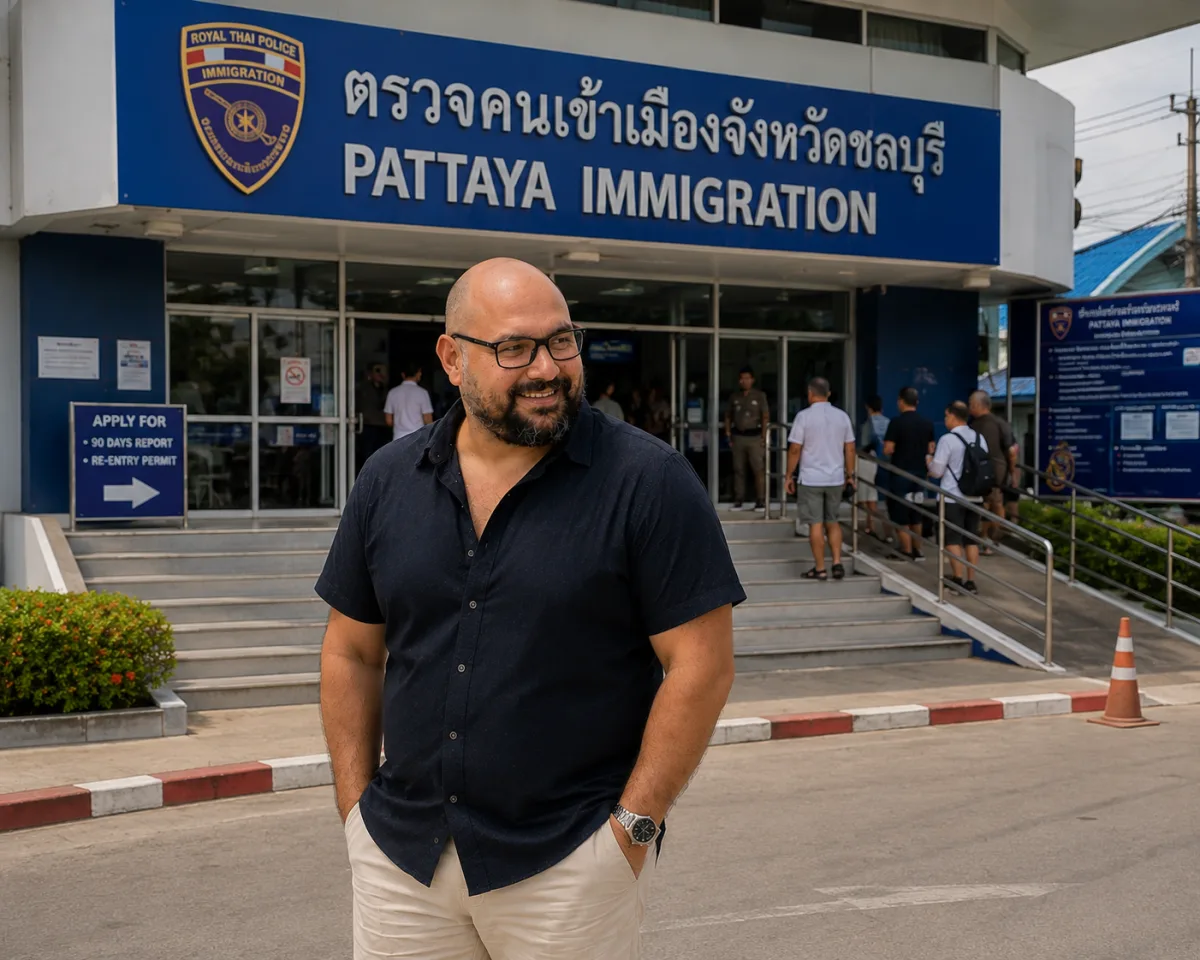
The visa exemption can be extended once at the Thai immigration office by 30 days, for a fee of 1,900 baht. This makes a total of up to 90 days at a stretch possible. For the first visit to the new property, for handover appointments or short stays, the visa exemption is usually sufficient.
What the visa exemption is not: a permanent solution. Anyone who returns regularly and spends several months a year in Thailand should consider a proper visa. Repeated visa runs every 60 days are viewed increasingly critically by the Thai immigration authority and can lead to entry being refused.
The LTR visa: 10 years for wealthy buyers
The Long-Term Resident Visa, or LTR for short, is the most interesting programme for wealthy buyers. It was introduced by the Thai government in 2022 with the express aim of binding international investors and retirees to Thailand over the long term. The programme is administered by the Board of Investment, or BOI for short.
The LTR grants residency for 10 years, divided into two consecutive five-year blocks. It costs 50,000 baht for the full 10 years, includes unlimited re-entries, a tax rate of zero per cent on foreign income remitted from abroad, and exempts you from the reporting obligation otherwise due every 90 days in favour of an annual report.
For property buyers, the Wealthy Global Citizens category is particularly relevant. The requirements in 2026: proof of assets of at least 1 million US dollars worldwide, of which at least 500,000 US dollars in Thai investments, that is, in things such as Thai real estate, shares or government bonds. One important change: the income threshold of 80,000 US dollars per year previously required was abolished without replacement for this category in February 2025. This means the LTR is now also within reach for investors without a high ongoing income, provided the assets are in place.
In practice this means: anyone investing in a Pattaya property with a purchase price in the high six figures and who has the required total assets qualifies for the LTR. The Thai property counts directly towards the required 500,000 US dollars in Thai investments. In this way, buying property combines sensibly with a long-term residency solution.
For retirees there is additionally the Wealthy Pensioners category: from age 50, with a demonstrable passive annual income of 80,000 US dollars, or 40,000 US dollars with an additional investment of 250,000 US dollars in Thai assets.
The DTV visa: the option for location-independent professionals
The Destination Thailand Visa, or DTV for short, was introduced in 2024 and is aimed at people who work remotely for foreign employers or as freelancers for foreign clients. For many buyers in their forties and fifties who are still professionally active and would like to relocate part of their work to Pattaya, the DTV is the right solution.
The key facts for 2026: a validity of five years, multiple entries possible, a stay of up to 180 days per entry, extendable once by a further 180 days at a stretch. The fee is around 350 euros. It requires proof of financial means amounting to 500,000 baht, for example through bank statements from the past three months, as well as evidence of foreign-based work, such as an employment contract, order confirmations or proof of your own company.
The DTV expressly permits remote work for non-Thai clients. Employment within Thailand itself remains not permitted. For the target group of digitally working owners of a Pattaya property, the DTV is often the best combination of flexibility, length of stay and manageable requirements.
The retirement visa: a classic from age 50
The classic retirement visa, formally the Non-Immigrant Visa O-A or O-X, remains an important route for retirees in 2026. The prerequisite is a minimum age of 50 plus either a monthly income of 65,000 baht or a fixed deposit in Thailand of 800,000 baht. Combinations of the two are also possible.
The O-A is issued for one year and is renewable. The O-X is aimed at buyers from certain countries, including Germany, with higher requirements but in return a validity of ten years. Health insurance with defined minimum benefits is mandatory. The bureaucratic effort is greater than with the LTR, but in return the financial hurdles are lower. For retirees who do not meet the LTR criteria, the O-A or O-X is often the solid standard solution.
The Thailand Privilege Visa: residency without proof of income
The Thailand Privilege Visa, formerly known as the Thailand Elite Visa, is a paid membership that grants a long-term residence permit independently of any proof of income or assets. Membership starts at 650,000 baht for five years and extends up to premium tiers with twenty-year terms and correspondingly higher fees.
For buyers who want a long-term stay without complications, without having to deal with BOI requirements or annual reports, the Privilege Visa can be a pragmatic solution. Compared with the LTR it is more expensive and offers fewer tax advantages, but in return it is easier to obtain and less prone to follow-up questions about the source of assets.

Which visa suits which profile?
From my advisory practice, four typical profiles can be distinguished, each of which can be matched with clear recommendations.
The occasional user, who spends two to eight weeks a year on holiday in their own condo, is well served by the visa exemption. There is no need for a genuine visa solution here.
The wealthy investor with substantial investment assets and a high-quality Pattaya property is in the right place with the LTR Wealthy Global Citizens. The Thai property counts directly towards the required investments in Thailand, the tax advantages are considerable, and the 10-year residency is the best planning basis on the market. Suitable investment properties include the Grand Solaire Pattaya or the Zenith Pattaya 2, both of which sit in the relevant price segment.
The location-independent professional in their forties or early fifties, who continues to work remotely for foreign clients and would like to spend a large part of the year in Thailand, is optimally set up with the DTV. The five years of validity and 180 days of stay per entry cover this typical situation in life precisely.
The classic retiree from age 50 with a sufficient monthly income or a fixed deposit in Thailand will get along well with the O-A or O-X retirement visa. Anyone who meets the criteria for the LTR Wealthy Pensioners should examine that option as a priority, as the terms are better.
Which route is the right one in your individual case depends on many details: age, income structure, financial situation, family circumstances, planned length of stay, tax residence back home. I am happy to support you in choosing the right programme and, if needed, to refer a specialised visa service provider with experience in cases like yours. An initial, no-obligation consultation is free of charge for buyers.
In my free Pattaya Property Guide you will also find the most important background information on buying, managing and residing in Pattaya, compactly summarised.
Frequently asked questions
More on buying property in Pattaya