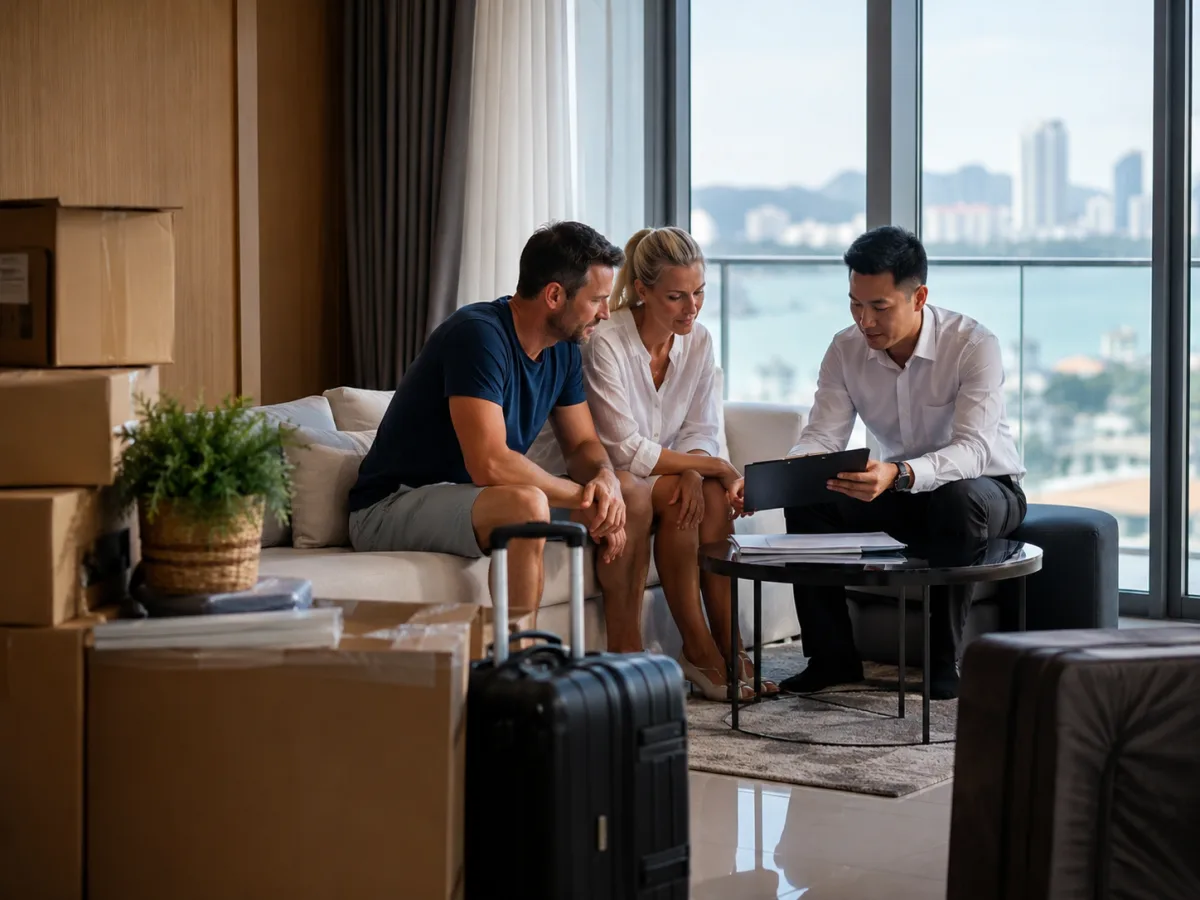
In brief: Handover in Pattaya follows clear steps: roughly 4 to 6 weeks before the appointment you transfer the final instalment (depending on your contract, 20 to 40 % of the purchase price) by international wire with an FET certificate. At inspection you document any faults on a defects list, which the developer rectifies within 30 to 60 days. On Transfer Day at the Land Office, around 1.5 to 2 % in incidental costs apply (transfer fee, stamp duty) plus a one-off sinking fund of 500 to 800 baht/m², after which you are entered into the land register and receive the keys.
Handover is the moment when a contract and a payment schedule turn into a real apartment that you can walk into, furnish and use. For many buyers it is the first step into the actual experience of living in Pattaya. To make sure this step goes smoothly, there are a number of things you should know and prepare.
I regularly accompany buyers through handover and know the points where the details tend to get tricky. This article is the compact, practical guide to it all, from the developer's invitation to the final transition into your own condo. Clearly structured, easy to follow, with the real figures and procedures in Pattaya 2026.
Free Guide
68 pages of Pattaya insider knowledge, download for free
What happens in the run-up to handover
The developer invites you as soon as the building is completed and the apartment is ready for handover. With off-plan projects, the period between signing the contract and handover is typically two to four years. In the weeks before handover you receive the official invitation with a proposed date and a list of documents to bring.
Important at this stage: the final instalment of the purchase price falls due. With most off-plan payment schedules, 20 to 40 percent of the purchase price is allocated to the final payment at handover. This sum must be transferred to Thailand from abroad, with the correct reference details stated for the later FET certificate. Without an FET certificate, which proves the foreign origin of the funds, the apartment cannot be registered in your name in the land register.
I recommend transferring the final instalment at least four to six weeks before the planned handover date, so that all bank-side confirmations are in place in good time. Anyone who leaves this too late risks a postponement of the handover.
The defects inspection: what you actually do on handover day
Defects are faults that the developer must rectify, before or after handover, at its own expense. The systematic defects inspection is the most important practical part of the handover. You go through the apartment together with a representative of the developer and document everything that is not in flawless condition.
What to look out for: walls and ceilings for cracks, discolouration and uneven paintwork. Floors for scratches and laying defects. Windows and doors for full operation, seals and locking mechanisms. Bathrooms for working taps, drains, toilet flush and silicone seals. The kitchen for the operation of all appliances, cabinet fronts and the extractor hood. Switch on the air conditioning units and let them run for at least fifteen minutes, then check the cooling and listen for any unusual noises. Check the electrics by switching everything on, and test the sockets with a tester you bring along.
Every fault is recorded on the defects list with a brief description and, ideally, a photo. You and the developer sign the list. The developer undertakes to rectify the faults within an agreed period, typically thirty to sixty days. Only once they have been rectified is the handover formally completed.
My advice from experience: set aside at least two to three hours for the defects inspection, and don't schedule another appointment immediately afterwards. Anyone who rushes overlooks points that are hard to enforce later. If possible, bring a second person along, four eyes see more than two.
The foreign quota confirmation at the Land Office
The foreign quota refers to the share of a condominium building that, under Thai law, may be held in full ownership by foreigners. This share is capped by law at a maximum of 49 percent of the total floor area. Before your apartment can be registered in the land register, it must be confirmed that your unit falls within this quota.
In practice, this check is handled by the developer together with the local Land Office. The requirement on your side is the complete FET certificate, which documents the correct transfer of the entire purchase price from abroad in Thai baht. Without an FET, or with a transfer in the wrong currency or with an unclear reference, considerable delays can occur, in the worst case lasting several months.
When you buy the apartment from a vetted developer, foreign-quota administration is routine and runs in the background. With second-hand purchases or with small, less experienced developers, it pays to clarify this point early, before the purchase, so there are no surprises at handover.
Transfer Day at the Land Office
The actual transfer of ownership takes place at the Land Office of the relevant district. This appointment is known as Transfer Day and is the formal act by which you are entered as owner in the Thai land register. You need to bring your passport, the FET certificate, the signed sales contract, the power of attorney for any representatives, as well as the final instalment of the purchase price.
On Transfer Day, the Thai acquisition costs fall due. The main items in 2026: a transfer fee of 2 percent of the officially assessed value, usually split equally between buyer and developer, i.e. 1 percent for you. Stamp duty of 0.5 percent, provided the developer is not subject to Specific Business Tax. Minor administrative fees in the low four-figure baht range.
Overall, you should budget around 1.5 to 2 percent of the purchase price for the acquisition costs at transfer, depending on the specific situation. These amounts are paid directly at the Land Office in Thai baht, usually in cash or by cashier’s check. The developer or your representative will know the exact sum you need to bring in advance.
Once all formalities are complete, you receive the Chanote, the Thai title deed, issued in your name. With that, the apartment is legally yours.
Common Area Fund, sinking fund and the ongoing costs
At handover, a one-off contribution to the sinking fund falls due, the reserve fund of the owners' association for major future investments such as roof renovation, lift replacement or façade repainting. In Pattaya the amounts are typically 500 to 800 baht per square metre of floor area, as a one-off payment. For a 50-square-metre apartment that comes to 25,000 to 40,000 baht.
In addition, handover marks the start of the monthly Common Area Fund, which finances the day-to-day running of the shared facilities, that is, cleaning, security, pool maintenance, lighting, lift service and garden upkeep. Typical rates in Pattaya 2026 are between 40 and 90 baht per square metre per month, depending on the building's level of amenities. For a 50-square-metre apartment that comes to 2,000 to 4,500 baht per month.
Both contributions are mandatory, governed by law in the Condominium Act, and are paid directly to the owners' association, represented by the building's Juristic Person Manager. Lost rental income or non-use of the apartment does not exempt you from the obligation to pay.
On top of this come your individual consumption costs for electricity and water according to your own usage, plus optionally internet and cable television. When you take possession of the apartment, the electricity and water meters are read and assigned to your name. Note down the opening readings on handover day, ideally with a photo, so that there are no disputes later about who used what.

Keys, access cards and resident registration
On handover day you receive the physical keys to the apartment as well as the electronic access cards for the communal areas. In modern Pattaya projects these are usually two to three cards per unit, granting access to the lobby, lift, pool, gym and parking. Additional cards can usually be ordered from the Juristic Person Manager for a small fee.
An important administrative point: resident registration with the Juristic Person. Even though the apartment is legally yours, you and everyone else who will live there regularly should register with the building manager using a passport and photo. This makes everyday life easier, from accepting parcels and visitor access through to having the correct address for any visa-related filings. In the case of letting, tenants must also be registered separately.
Anyone who lets the apartment immediately or leaves it unattended should have a trustworthy property manager or an authorised representative on the ground. Water damage, power cuts, repairs or matters within the owners' association can call for short-notice decisions that cannot be handled from abroad.
After handover: what matters in the first few weeks
In the first few weeks after handover it pays to put the apartment through its everyday paces. Run the air conditioning units for several hours at a time, use every tap and drain over several days, and actively use each socket at least once. Small faults that went unnoticed during the one-off handover often only show up in use.
Most developers in Pattaya grant a warranty of twelve to twenty-four months on structural and major faults, similar to the German warranty on new builds. Note down any points that arise later and report them to the developer in writing, ideally with a photo and date. That way your claims remain documented.
Anyone letting the apartment should, by this point at the latest, sort out a rental agreement, a property manager and the Thai tax situation. I'm planning a separate follow-up article on that.
My offer: on request, I personally accompany buyers through handover, from the defects inspection to Transfer Day at the Land Office. A no-obligation consultation on your own handover is free of charge for buyers. In my free Pattaya Property Guide you will also find the most important legal and practical fundamentals summarised in compact form.
For more on the fundamentals of buying off-plan, see my article Off-Plan in Pattaya 2026: Opportunities, Risks and What Really Matters. If you're planning to spend a longer period in Pattaya, the article on Visas and Residence 2026 offers the right overview.
Frequently asked questions
More on buying property in Pattaya