In short: The "dark towers" in Pattaya are no proof of mass vacancy. Anyone standing on Beach Road in the evening and seeing only the occasional light in the high-rises is confusing two completely different things: a dark window means an absent owner, not an unsold unit. Pattaya is a second-home and holiday city – many condos belong to people who are only there part of the time. The actual ownership and occupancy rate is significantly higher than the night-time impression suggests.
The Vacancy Myth in Pattaya – Where the Image Comes From
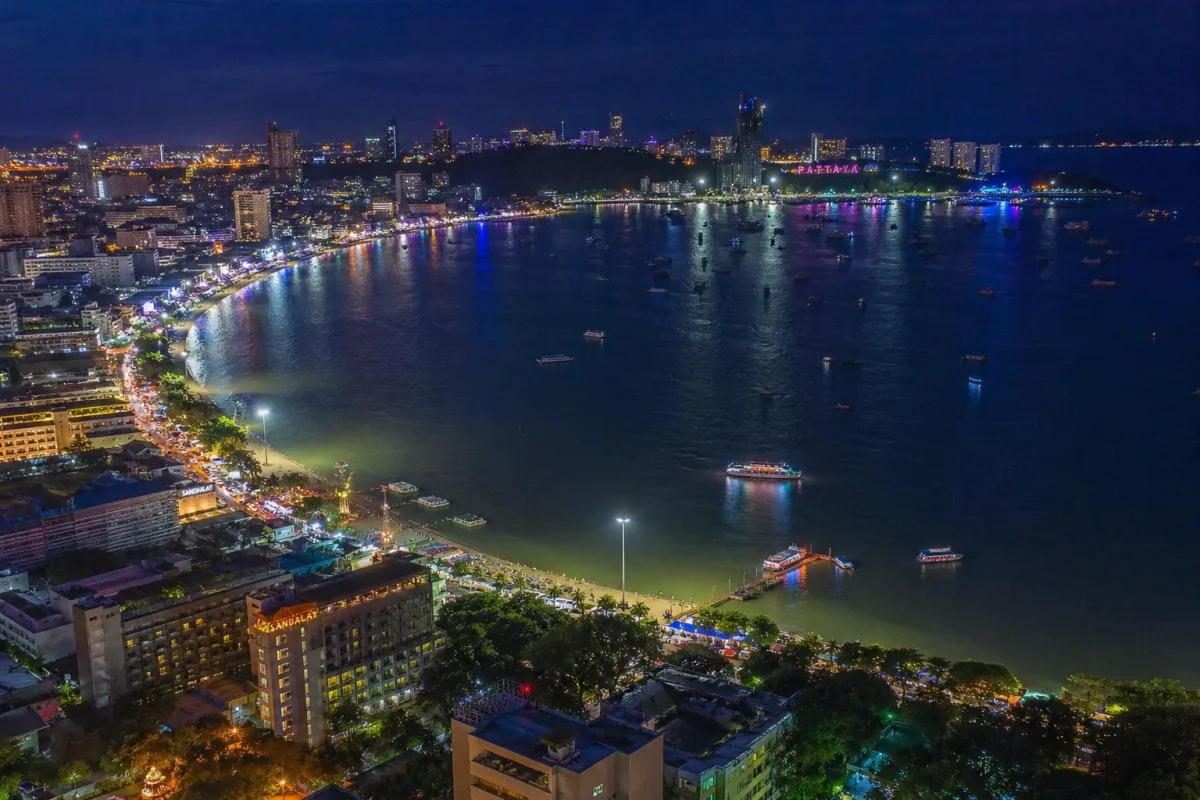
It is an image that has stuck: you drive along the beachfront in the evening, look up at the glittering high-rises – and only a handful of windows are lit. The spontaneous conclusion seems obvious: "The towers are standing empty." Over the years this impression has grown into a stubborn myth that keeps doing the rounds in forums, videos and bar-stool conversations – the supposedly dramatic vacancy rate in Pattaya.
The problem with this image: it conflates three fundamentally different states that need to be kept clearly apart. A unit can be unsold (still belonging to the developer), it can be sold but currently unoccupied (the owner is not there), or it can be rented out and actually in use. Only the first case represents genuine market oversupply. The other two are simply the normal state of affairs in a holiday and retirement city – and not a warning signal.
This is precisely the distinction that night-time observers rarely make. A dark window says nothing about whether the apartment behind it has an owner. It only says that nobody has switched the light on at that moment.
Dark does not mean empty – it means absent
Estimates from the local market suggest that at night often only 10 to 20 percent of units in a typical Pattaya high-rise are illuminated. Drawing the conclusion that 80 percent are standing empty is the same logical error familiar from Western cities. In Vancouver – a classic case study in the "dark windows debate" – the public believed for years that tens of thousands of owner-occupied apartments belonging to foreign owners were vacant. A rigorous study then found that only around 5.5 to 8 percent were actually unoccupied. The rest belonged to people who simply did not live there permanently.
Pattaya works in exactly the same way, only more so. The city is not a commuter hub but one of Southeast Asia's best-known holiday, second-home and retirement destinations. Ownership is high, but use is seasonal and intermittent. That is the entire explanation for the dark windows – and it has nothing to do with a sick market.

Who Really Owns the Condos – and Why They Are Dark
To put the impression in context, it is worth looking at the typical ownership structure in Pattaya. Unlike a rental apartment in Munich that is occupied every evening, condos here are predominantly owned by people whose main home is not in Pattaya year-round.
| Owner Type | Typical Use | Windows in the evening usually… |
|---|---|---|
| Snowbirds (DACH/Europe) | 3–6 winter months, rest of the year at home | dark outside the season |
| Second-home owners | Several short stays per year, holidays | mostly dark |
| Investment buyers (rented out) | Unit is rented, tenants change | lit when occupied |
| Permanent residents | On-site year-round | regularly lit |
Add that up and the picture is clear: in a building where half the owners are snowbirds and second-home owners, it is entirely normal in April or August for the majority of windows to remain dark. These units are sold, paid for and maintained – their owners are simply sitting in Zurich, Vienna or Hamburg right now.
Seasonality is the decisive factor
Pattaya breathes to an annual rhythm. The high season from November to February brings full beaches, fully booked hotels and – unsurprisingly – noticeably more lit windows. In the low season around the rainy season, the on-site presence thins out. Anyone judging the city on a June night sees it at the lowest point of its occupancy cycle. It is like visiting a ski resort in midsummer and concluding that it is permanently empty. You can read more about this rhythm in the article on climate and the best time to visit Pattaya.
The Real Numbers: Occupancy, Rentals and Absorption
Let us set aside the night-time impression and look at reliable market data. Here it becomes clear that "dark tower" and "weak market" are two very different things.
Rentals are working – with a clear seasonal curve
In the long-term rental segment, solidly occupied units are the rule rather than the exception. Well-positioned new-build condos in sought-after locations such as Central Pattaya and Jomtien achieve stable rents; realistic gross rental yields are consistently in the range of around 5 to 8 percent per year. In the short-term/holiday segment, occupancy fluctuates heavily with the season: top properties achieve high occupancy in the high season, while the average annual holiday-rental occupancy is lower – but that is by design, since these units are not permanent residences. The article Rental Yield Explained Realistically explains how these return figures actually come about.
Absorption: the market sells what is built
Perhaps the most important indicator against the vacancy myth is the absorption rate – the proportion of units offered that are actually sold. For the Pattaya condo market this figure stands at around 76 percent in current analyses. That is a high figure that shows: there is demand from buyers with purchasing power, and developers are responding with a focus on quality rather than blind volume. Off-plan projects from vetted developers are often largely sold before completion – pre-sales are the financial backbone of these projects.
It is also true that within the broader Eastern Seaboard area there is a stock of unsold units, particularly in individual locations that saw especially high construction activity at certain times. But this is not widespread vacancy; it is normal market behaviour in a growing market – and this is precisely where the wheat is separated from the chaff. Selecting the right project and the sound developer is my job on the ground. That is what I am here for.
What you will NOT find in the numbers
The credible market reports for 2026 describe Pattaya as stable, selective and opportunity-oriented. Prices have settled on a broad front, demand is consistent, and buyers are better informed than in earlier cycles. What you will not find anywhere: the image of a ghost town with row upon row of unsellable towers. Long-term value appreciation remains upward-trending at around 3 to 5 percent per year, supported in part by the region's infrastructure momentum. More on this in the article on EEC Infrastructure as an Investment Driver.
What All of This Means for You as a Buyer
The vacancy myth is not only factually wrong – it also leads to wrong conclusions when making a purchase decision. Anyone who believes "everything is standing empty" misses real opportunities. Anyone who understands how the market actually works buys with more precision.
- Dark windows next door are not a defect. They are a hallmark of a holiday and second-home city. In a quiet building with many seasonal guests you may actually live more peacefully – less noise, less turnover.
- Location and developer trump generalised market fear. "The Pattaya market" does not exist as a single entity. Wongamat operates differently from Na Jomtien; a vetted off-plan developer operates differently from an ageing resale block. The neighbourhood comparison shows which location suits you.
- Off-plan remains attractive. Entering early during the construction phase is often up to 40 percent cheaper than at completion – a pure capital-appreciation advantage that has nothing to do with the occupancy debate. Details in the guide Buying Off-Plan in Pattaya.
- Check rentability rather than counting lit windows. For investors what counts is not the proportion of lights on at night, but whether the unit rents well. Modern new-build units with resort facilities have the edge here.
Two examples from our projects
Current off-plan projects give a concrete picture. Zenith Pattaya 2 starts at around 100,000 THB/m² and is aimed at buyers who want to enter a growing market early and with price awareness. Aquarous Jomtien sits in the Foreign Quota at approximately 138,000 to 217,000 THB/m² and combines beach proximity with modern facilities – exactly the kind of unit that rents and resells well later on. An overview of all current projects can be found in the project overview.
What a Condo Really Costs – Beyond the Purchase Price
A complete picture also requires acknowledging that "dark" units cost money even when nobody is living in them. Common area fees and the sinking fund continue regardless of occupancy. That is precisely why most owners maintain their unit and do not let it deteriorate – a vacant, neglected condo would make no economic sense. Anyone who wants to plan running costs realistically will find the details in the article on running costs, as well as an honest full-cost calculation at What a Condo Really Costs.
Frequently Asked Questions About Vacancy in Pattaya
Are entire high-rises in Pattaya really standing empty?
No. The impression is created by dark windows behind which absent owners stand – snowbirds, second-home owners, holiday guests. Real vacancy in the sense of unsold units affects individual locations with high construction activity, not the market as a whole. The absorption rate is around 76 percent.
So why are so few lights on at night?
Because Pattaya is a holiday and retirement city. Many owners only use their condo occasionally or seasonally. In the low season – around the rainy season – the dark impression is strongest. In the high season from November to February, noticeably more windows are lit.
Is vacancy a risk for my resale?
For a modern, well-located unit from a vetted developer the risk is low. Such units are in demand and can be rented out as well as sold. What matters is location, build quality and developer – not the general impression of the city. I handle the selection of the right project for you on the ground.
Do dark neighbouring units affect my rental yield?
Not directly. Your return depends on your own rental performance, not on whether your neighbours have their lights on. A realistic gross rental yield of around 5 to 8 percent per year is achievable for a well-rentable unit in a sought-after location.
Should I buy resale instead of new-build because of the vacancy issue?
Quite the opposite. Modern new-build units with resort facilities have proven to rent and sell more easily than older existing blocks that increasingly have to compete on price. Off-plan entry also offers a price advantage of up to 40 percent compared to completion.
You want to know which unit in which location genuinely makes sense for you – beyond all the myths? I look at the market on the ground every day and will tell you honestly where entry is worthwhile. Get in touch with no obligation via the contact form or download my free guide first. Note: This article is not investment advice; prices mentioned are indicative.
Free Guide
68 pages of Pattaya insider knowledge — download for free