Many buyers from German-speaking countries arrive in Pattaya with the same wish: a house of their own with a garden, perhaps a small pool, everything exactly as they imagined it. The first big question quickly arises: buy an existing house or acquire a plot and have something built? Both are possible, but the two routes differ enormously in effort, control, cost and risk.
This article compares both options honestly and practically. The focus here is deliberately on the decision to buy or build, not on the legal details of ownership structures. The legal basics on leasehold and company ownership are covered separately — see Buying a House as a Foreigner: Leasehold or Company.
The Starting Point: Who Actually Owns the Land?
The key difference from Germany, Austria or Switzerland: foreigners cannot directly own land in Thailand. You can very much hold the building itself in your name, but you cannot buy the land beneath it in the conventional sense. In practice, foreigners use two routes for this:
- Leasehold: You lease the land long-term, typically for up to 30 years, with possible renewal options. The house belongs to you; the land remains in the ownership of the Thai owner or developer.
- Thai Limited Company: A Thai company holds the land. This structure must be set up and maintained correctly, otherwise legal complications may arise.
What matters for the buy-or-build question: in both cases you are building or buying a house that sits on land you do not own 100% outright. This is precisely what makes building on leased land more complex for many first-time buyers than purchasing a condo — something we touch on at the end.
Buying a House: Fast, Predictable, Fewer Surprises
Buying an existing house or a finished villa is the most straightforward route. You see exactly what you are getting, can inspect the property, have defects professionally assessed and, in the best case, move in within a few weeks. Prices vary greatly by location, size and fit-out, but the most important characteristic is predictability: a fixed purchase price instead of an open-ended construction budget.
The downsides: you are buying the taste of the previous owner or developer. The floor plan, materials and build quality are already set. For older houses, a technical survey is worthwhile, as a common problem in Thailand is settling foundations and hidden defects. An honest assessment before purchase saves a great deal of money later.
Having It Built: Maximum Control, Maximum Effort
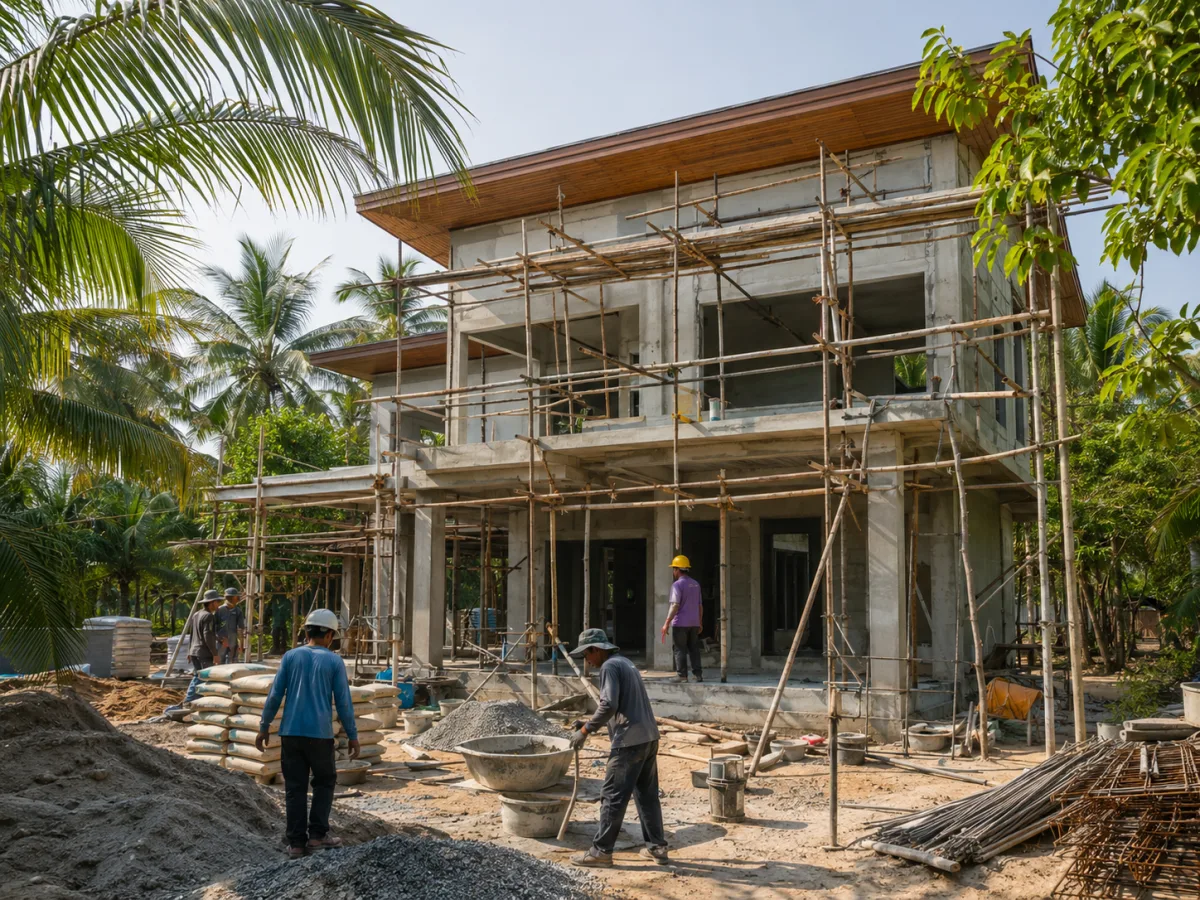
When you build, you design everything yourself: floor plan, room layout, materials, pool, garden. That is the great appeal. The price you pay is effort and responsibility. You need a suitable plot, a building permit, a reliable contractor and, above all, functioning site supervision.
Build times for a single-family home or villa with reputable providers in Pattaya are typically around 6 to 12 months, depending on size and fit-out. Realistically, you should factor in contingency: two consecutive poor rainy seasons can stretch a project to as long as 22 months. Anyone planning around a fixed move-in date — particularly for a relocation from a German-speaking country — should account for this.
Construction Costs per Square Metre in Pattaya
The table below shows rough ranges for pure construction costs (shell and fit-out, excluding land, garden, boundary walls or furnishings). These are indicative figures drawn from builder and market data for 2025/2026, not fixed prices. In sought-after locations like Pattaya, prices tend to be at the upper end of the ranges.
| Fit-out Level | Construction Cost per m² (THB) | Example 160 m² |
|---|---|---|
| Basic / Entry Level | approx. 12,000 – 18,000 | approx. 1.9 – 2.9 million |
| Mid-range Quality | approx. 18,000 – 30,000 | approx. 2.9 – 4.8 million |
| Premium / Luxury | approx. 30,000 – 45,000+ | from approx. 4.8 million |
Land comes on top. Plot prices in Pattaya average around 22,000 THB per m² (asking prices), though the range varies enormously by location and the market has risen noticeably in recent periods. Anyone building should therefore budget for construction costs and land separately and honestly, including garden, boundary walls, utility connections and all external works.
Permits, Site Supervision and the Risk of Managing from Abroad
Building without a permit is not an option: in Pattaya, the building permit process typically takes two to three months after submission of documents. Anyone who builds without a valid permit risks fines of up to 60,000 THB and, in extreme cases, a stop-work order or even a demolition order. The building permit can be issued in the foreigner's name; a site manager must be registered with the authorities.
The biggest practical risk factor is site supervision. Experienced owner-builders in Thailand consistently advise: do not build from a distance and do not rush it. In concrete terms this means:
- Presence on-site: Anyone who does not keep a regular eye on the tradespeople risks execution errors that become costly to remedy later.
- Payment in instalments: Never pay the full amount upfront — pay in small increments after work is completed. Otherwise you risk the construction crew disappearing with the money.
- Reputable contractor: References, completed projects and a clear written contract with a detailed scope of works are essential.
Anyone building from Germany, Austria or Switzerland and visiting only a few times a year is giving up a large part of the control — precisely where control matters most.
Buy or Build: The Honest Comparison
There is no universally correct answer, but there is a clear tendency depending on your life situation:
- Buying suits you if you want to move in quickly, need price certainty and cannot be on-site for months at a time.
- Building suits you if you have very specific ideas, are spending an extended period in Pattaya anyway and genuinely enjoy the project — including a willingness to take supervision seriously.
Anyone who wants to assess value appreciation and market prices will find current figures in our Pattaya Off-Plan Price Report 2026.
Note: This article is intended as general orientation only and does not constitute legal, tax or construction advice. Permit requirements, ownership structures and tax considerations are subject to change and depend on individual circumstances. Always consult official sources and seek qualified professional advice before taking any action.
Frequently Asked Questions
Can a foreigner have a house built in Pattaya?
Yes. You can hold the building in your own name and the building permit can be issued in your name. Foreigners typically access the land itself via leasehold (usually up to 30 years) or a Thai company, as direct ownership of land by foreigners is generally not permitted.
How much does it cost to build a house in Pattaya?
As a rough range for pure construction costs, expect approximately 12,000 to 45,000+ THB per m² depending on the fit-out level, excluding land and external works. In sought-after locations like Pattaya, prices tend to be at the upper end. Land currently adds around 22,000 THB per m² as a market average, varying greatly by location.
How long does it take to build a house in Pattaya?
With reputable builders, typically around 6 to 12 months depending on size. Realistically, you should allow for contingency: rainy seasons and delays can extend a project to up to 22 months.
What is the biggest risk when building from abroad?
The lack of on-site supervision. Without regular presence on the ground, execution errors increase and so does the risk of paying too much upfront. Experienced owner-builders strongly advise against building hastily and from a distance.
Is buying or building cheaper?
There is no blanket answer. A finished house has a fixed, predictable price. When building, you can control the fit-out and costs, but you bear the risk of cost overruns, delays and defects. For planning certainty, buying is usually the calmer route.
Our honest conclusion: both paths work, but they suit different people. If you have a clear project vision and can be on-site, building your own home can be a deeply rewarding undertaking. For most buyers from German-speaking countries who want to get started straightforwardly and with full ownership security, a freehold turnkey condo is often the more relaxed solution: no leased land, no site supervision, no permit phase — just direct ownership of the unit. We will show you the options honestly and without pressure, from self-build houses to condos, so you can choose the path that genuinely suits you. Feel free to arrange a free initial consultation or download our free guide first.
Free Guide
68 pages of Pattaya insider knowledge — download for free