In short: As an international buyer, the safest way to buy a condo in Pattaya is within the so-called Foreign Quota as Freehold – meaning genuine, indefinite full ownership in your own name on the title deed (Chanote). Up to 49% of the floor area per building may go to foreigners; only this share allows Freehold. Leasehold (a 30-year right of use) is the alternative when the quota is full – but for most international investors Freehold is the better choice, and with a vetted off-plan developer it is usually exactly what's available.
Foreign Quota in Pattaya: the 49% rule in the Condominium Act
The legal basis for foreign condo ownership in Thailand is the Condominium Act B.E. 2522 (1979), amended several times. It allows foreigners to own a condominium unit in their own name – as genuine Freehold property registered in the Thai land registry. The central condition: in every condominium building, no more than 49% of the total sellable floor area may pass into foreign hands. The remaining 51% is reserved for Thai owners or Thai companies. This foreign share is called the Foreign Quota.
Important to understand: the 49% applies per building and by square metres – not per unit and not per overall project. In a complex with several towers, one tower may be fully used up while another still has Foreign Quota available. So for you as an international buyer, only one question matters: is Freehold quota still available for your specific unit? That is exactly what I clarify for you before every reservation – in writing and bindingly with the developer.
With a new build or off-plan purchase this is a clear advantage: those who get in early secure the sought-after Freehold units with sea or city views before the quota runs low. More on this in the article Buying Off-Plan in Pattaya.
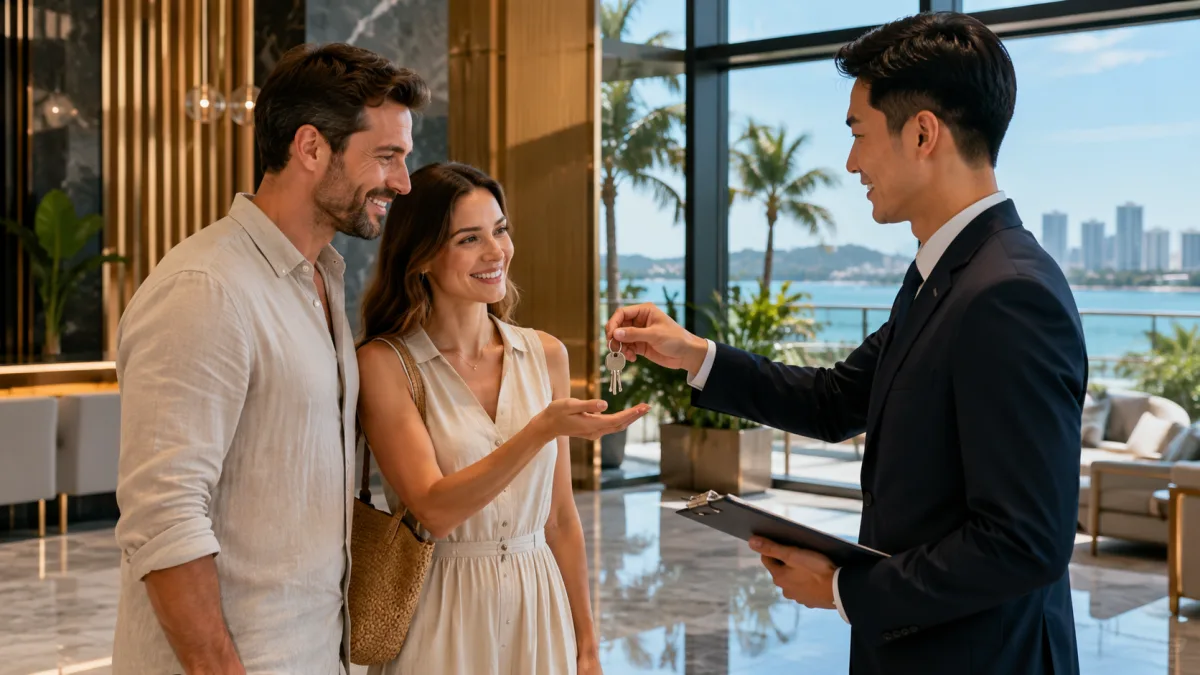
Freehold: genuine full ownership in your name
Freehold is the form of ownership that international buyers intuitively expect: indefinite full ownership. Your name is entered on the Chanote (the highest Thai land-title for the unit). There is no expiry date, and you can rent out, sell, gift or bequeath the unit at any time.
The advantages in practice:
- Resale: Freehold units are considerably easier to sell and usually fetch better prices – the pool of buyers is larger.
- Inheritance: Heirs can take over the ownership (for registration to a foreign heir, the quota and foreign-currency-proof rules then apply as well; alternatively the estate can sell the unit).
- Legal security: Registration on the Chanote is the strongest proof of ownership Thai law recognises.
- Value stability: In established locations such as Wongamat, Pratumnak or Jomtien, Freehold property holds its value particularly well.
My clear recommendation remains: buy Freehold whenever possible. With my vetted off-plan developers, Freehold quota for international buyers is, as a rule, reserved and available – for example at Grand Solaire Noble, Aquarous Jomtien or Zenith Pattaya 2.
Leasehold: the long-term right of use
Leasehold is not ownership but a right of use registered in the land registry. The statutory maximum term of a single registration is 30 years. It is often advertised as „30 + 30 + 30 years“ – but legally binding at first is only the first 30-year period. Renewals are agreed by contract, yet they depend on the creditworthiness and continued existence of the owner/developer.
Leasehold is not inherently bad – it can make sense when the Freehold quota in a desired property is exhausted and you want precisely that location. The key is to assess its characteristics correctly:
- With every year, the remaining term shrinks – and with it, typically, the resale value.
- The pool of buyers at resale is smaller than with Freehold.
- A foreign-currency transfer record (FET) is not mandatory with Leasehold – that sometimes makes payment handling more flexible, but it changes nothing about the points above.
For most international investors focused on value stability and easy resale, Freehold is the calmer choice. Which form suits you depends on location, holding period and objectives – we discuss that individually.
Freehold vs. Leasehold: the direct comparison for Pattaya
| Feature | Freehold (Foreign Quota) | Leasehold |
|---|---|---|
| Legal form | Full ownership | Right of use (lease) |
| Land-registry entry | Chanote in your name | Lease entry on the back of the Chanote |
| Term | Indefinite | Max. 30 years per registration |
| Renewal | Not needed | By contract, only 1st period firmly binding |
| Foreign-currency record (FET) | Required | Not mandatory |
| Resale | Easy, large buyer pool | Harder, falls with remaining term |
| Inheritance | Possible (quota/FET rules apply) | Only remaining term transferable |
| Recommendation for international buyers | First choice | When quota is full & location desired |
What international buyers need to bear in mind in practice
With a Freehold purchase in the Foreign Quota, three formal steps come together. I handle these with the developer – but you should still understand them:
1. Bringing money into Thailand correctly (FET certificate)
The purchase price must be transferred to Thailand in foreign currency and converted into Baht there. The Thai bank issues the FET certificate (Foreign Exchange Transaction Form, formerly „Thor Tor 3“) for this. It proves the funds came from abroad – and is the prerequisite for Freehold registration. Without the FET, the Land Department will generally refuse registration as foreign Freehold property. Practical note: an FET is usually only issued for a transfer of over USD 50,000; for smaller amounts a SWIFT-based bank confirmation is often sufficient. Details in the article Money Transfer & FET Certificate.
2. Name registration & Chanote
At handover (for a new build, after completion), your name is registered at the Land Department. You receive the Chanote for your unit – with unit number, square metres and your co-ownership share of the common property. Items to bring include your passport, the FET, the Foreign Quota confirmation from the owners' association (debt-free letter) and the purchase contract.
3. Your own lawyer – when does it make sense?
With a new build from a vetted developer, the contracts are standardised and have been reviewed many times – a separate lawyer is then not necessary; that is precisely my job for you. With a resale (private purchase), by contrast, I recommend an independent legal review to confirm quota status, freedom from debt and ownership standing cleanly. That way you use the buyer's advantage without incurring unnecessary costs.
Example scenarios: how it looks in concrete terms
The following cases are anonymised, purely illustrative examples – not real customer data.
- Scenario A – Freehold studio in Jomtien: An international couple reserves a 30 m² studio in the Foreign Quota early in the construction phase. Off-plan price around 138,000 THB/m², i.e. roughly 4.14 million THB (~€106,000). Payment by international transfer, FET is issued, and on completion the name is entered on the Chanote. Ownership indefinite, fully rentable (target yield around 5–8% p.a. gross). You'll also find price examples in the Off-Plan Price Report 2026.
- Scenario B – Leasehold when the quota is full: In a highly sought-after Wongamat tower, the Freehold quota is exhausted. Anyone who wants precisely this location opts for Leasehold (30 years). It's registered as a lease, no FET needed. For owner use over a clearly defined period this can fit – but for pure capital growth, Freehold in another property would be the more solid choice.
- Scenario C – a 2-bedroom as an investment: An investor seeks value stability and easy resale. We choose Freehold in a project with guaranteed available quota, e.g. Copacabana Coral Reef. Total price in the 2-bedroom range roughly €180,000–250,000, depending on size and floor.
The off-plan advantage: in the early construction phase, units can be up to 40% cheaper than at completion – that is capital-growth potential (not the rental yield). On top of that comes the ongoing market price increase of about 3–5% p.a. These three figures should be kept cleanly apart; more on this under Rental Yield Explained Realistically.
The legal framework in brief – and where to dig deeper
Foreign Quota, Freehold and Leasehold are only part of the picture. If you want to understand the full legal framework, you'll find the fundamentals in the article The Condominium Act Explained. For the overall calculation, it's worth looking at Taxes on a Condo Purchase and running costs (Common Area Fee & Sinking Fund). All prices here are guide values and not investment advice; portal prices are listings, not actual transactions.
Frequently asked questions about Foreign Quota, Freehold and Leasehold in Pattaya
Can foreigners really acquire ownership of a condo in Thailand?
Yes. The Condominium Act allows foreign buyers genuine Freehold full ownership of a condominium unit – within the 49% Foreign Quota per building and with registration on the Chanote in your name.
What happens if the Foreign Quota in my desired property is full?
Then Freehold is no longer possible there. The alternatives are Leasehold (a 30-year right of use) in the same property – or, usually the better solution, a comparable Freehold unit in another building/project. This is exactly where I advise you.
Do I absolutely need the FET certificate for a Freehold purchase?
For Freehold registration at the Land Department, yes: the purchase price must come into Thailand as foreign currency and be evidenced via the FET. With Leasehold, by contrast, FET proof is not mandatory.
Is Leasehold generally to be avoided for international buyers?
No, but it is the second choice. For long-term value retention and easy resale, Freehold is better. Leasehold can make sense when the quota is full and you want to use precisely that location over a clear period.
Is a separate lawyer worth it for a new build?
With a new build from a vetted developer, the contracts are standardised – a separate lawyer is not necessary; I handle that. With a private resale, an independent review is advisable.
Your next step
Foreign Quota, Freehold and Leasehold sound complicated – in practice I clarify it for you within a few days, including a binding quota confirmation and clean payment handling. Just tell me which location and budget you have in mind, and I'll find the right Freehold unit. Write to me with no obligation via the contact form – or download my free guide in advance, which explains the entire buying process step by step. For an overview of all current new-build projects, see the project overview.
Free Guide
68 pages of Pattaya insider knowledge — download for free