In short: The sale contract (Sale & Purchase Agreement, or SPA for short) is the central document when buying a condo in Thailand. For a new-build purchase from the developer it is standardised by law and strongly buyer-friendly – including late-delivery penalties, warranty cover and capped fees. Anyone who knows the key clauses and works with an experienced agent can sign with peace of mind – and for a new build you usually don't even need your own lawyer.
From reservation form to SPA: how the purchase works in Pattaya
Before the actual sale contract is signed, there is almost always a reservation agreement. With it you take your desired unit – say a corner studio with sea view on the 30th floor – off the market. In Pattaya a reservation fee of 50,000 to 100,000 THB is typical (around €1,300–2,600), which is later credited in full against the purchase price.
The typical process in three steps:
- Step 1 – Reservation: Unit, price and payment plan are fixed in writing. The unit is blocked for you from that moment on.
- Step 2 – Signing the SPA: Usually within 14 to 30 days of the reservation. On signing, the first contract instalment generally falls due (often 20–30% of the purchase price, depending on the project and construction stage).
- Step 3 – Payment plan & handover: The remaining instalments follow the agreed plan through to completion; with the final payment, ownership is registered in your name at the Land Office.
The beauty of an off-plan purchase: you lock in the early-construction price – sometimes up to 40% cheaper than at completion – and pay conveniently in stages as the building rises. How this works in detail is something I explain in the post Buying off-plan in Pattaya.
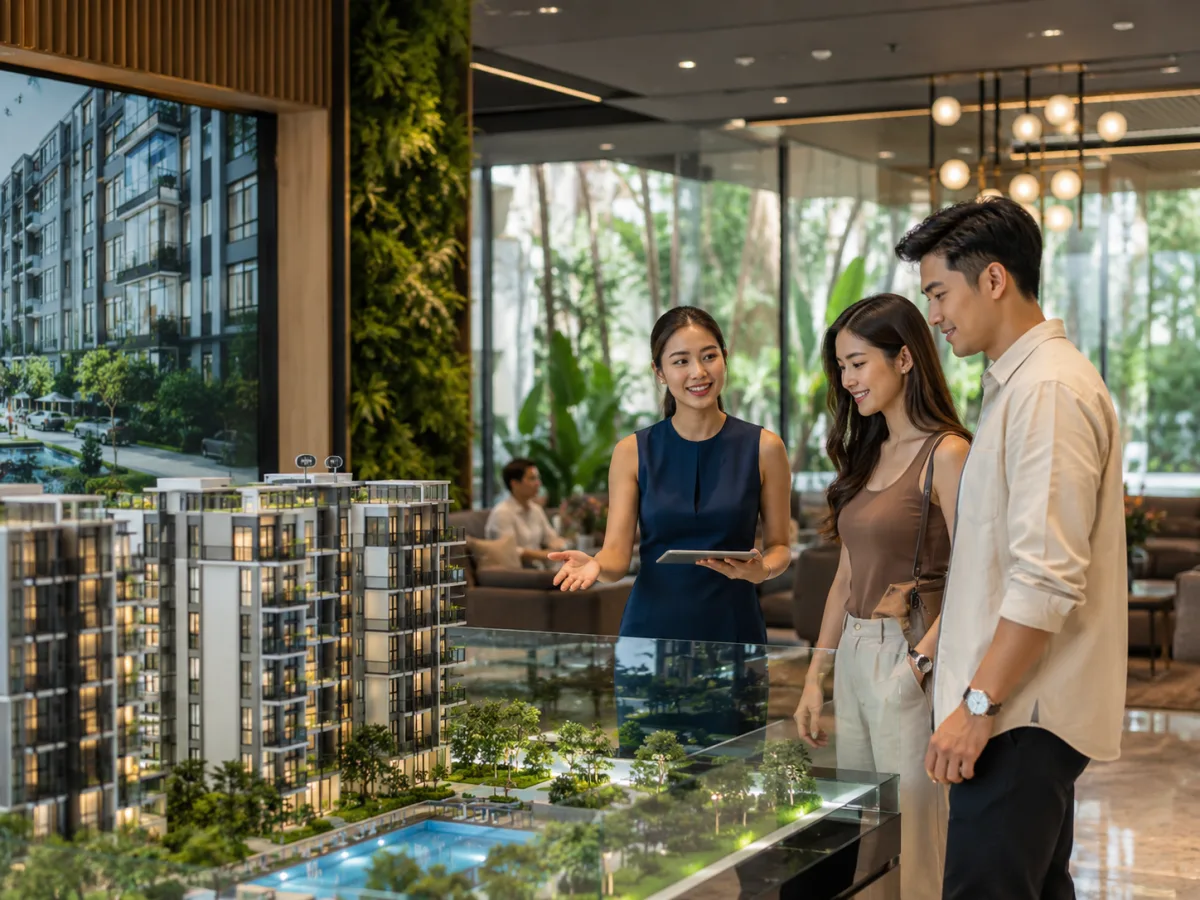
Condo sale contract in Pattaya: these elements belong in every SPA
A complete SPA for a condo in Thailand typically runs to 15 to 25 pages and covers at least the following points:
- Contracting parties: developer (with company registration) or seller, and buyer with passport details.
- Precise unit description: project name, building, floor, unit number, living area in m² – including a rule for what happens if the area deviates after final measurement (typically: pro-rata price adjustment, with a right of withdrawal from around 5% deviation).
- Form of ownership: express assurance of Foreign Quota Freehold – that is, full foreign ownership within the building's 49% quota.
- Purchase price and payment plan: each instalment with amount and due date, ideally tied to construction milestones.
- Completion and handover date: a concrete date, not a vague "expected".
- Specification: exactly what is included – "fully fitted" (kitchen, air conditioning, bathroom fittings) or "fully furnished" (completely furnished).
- Default and withdrawal rules for both sides (more on this shortly).
- Warranty: by law 5 years on the building structure, 2 years on all other components from handover.
- Allocation of additional costs: transfer fee, sinking fund, common area fee – who pays what.
If one of these points is missing, ask about it – in the projects I broker, all of these points are cleanly regulated; I check this before a project even enters my portfolio.
The payment plan: typical structure and sensible clauses
The payment plan is the heart of every off-plan SPA. In Pattaya the following pattern has become established:
| Phase | Typical share | Timing |
|---|---|---|
| Reservation | 50,000–100,000 THB | immediately |
| Contract signing | 20–30% | 14–30 days after reservation |
| Construction instalments | 30–50% | monthly or by milestone |
| Final payment | 20–40% | at handover & transfer of ownership |
There are three things you should keep in mind with the payment plan:
- Milestone linkage: instalments tied to construction progress (e.g. "on completion of the structural shell of floor 20") are more transparent than purely calendar-based instalments. Many of Pattaya's top developers offer exactly this.
- A high final share = buyer advantage: the larger the instalment at handover, the later your money flows out. On some projects, 30–40% only falls due at completion.
- Transfer from abroad: pay the instalments in foreign currency from abroad into Thailand – this is the only way to obtain the FET certificate needed for registering ownership. All the details are in the post Transferring money to Thailand & the FET certificate.
For how to align the payment plan optimally with your cash flow – including worked examples – read Financing a condo in Pattaya: the payment plan.
Handover, delay and warranty: what the law settles for you
This is where you can see how buyer-friendly Thai law is on new builds. Since the amendment to the Condominium Act (Section 6/2), developer contracts must conform to the official standard form Or.Chor. 22 – clauses that put the buyer in a worse position are simply invalid. In concrete terms this means:
Developer delay
- If handover is delayed, you are entitled to a late-delivery penalty of at least 0.01% of the purchase price per day – capped at 10% of the purchase price. For a condo costing 5 million THB, that is 500 THB per day, up to a maximum of 500,000 THB.
- Alternatively, in the event of a significant delay you can withdraw from the contract and receive your payments back.
Handover
- Before the final payment there is a joint inspection. Defects go onto a "snag list" and are remedied before or shortly after handover – routine with good developers.
- Only after inspection and final payment does the transfer take place at the Land Office – so you never pay "blind" for an unfinished product.
Warranty
- 5 years on the load-bearing structure (foundation, walls, ceilings).
- 2 years on all other components (installations, windows, fittings).
These protective mechanisms are a key reason why buying a new build from an established developer in Thailand is so straightforward. I've set out the legal background in detail in the post The Condominium Act explained.
New build vs. resale: two different contract worlds
One of the most frequent questions from my clients: "Do I need my own lawyer?" The answer depends on who you are buying from:
New build from a vetted developer: standardised and safe
With an off-plan or new-build purchase, the SPA is standardised by law (Or.Chor. 22) and identical for all buyers in a project. Nothing individual is negotiated here – and that is precisely your advantage: the buyer-friendly minimum standards (late-delivery penalty, warranty, fee cap) are firmly anchored, and any clauses to your disadvantage are invalid. You usually don't need your own lawyer here – saving you 40,000 to 80,000 THB in review costs. The real due diligence lies elsewhere: in choosing the right developer with a clean balance sheet, EIA approval and a track record. That's exactly what I'm here for – I have personally checked every project in my portfolio.
Resale / private purchase: here a lawyer is worth it
It's different with a resale, i.e. buying an existing unit from a private owner: there is no standard form here, and every contract is individual. Things to check then include whether the title deed is free of encumbrances, outstanding common-area fees, the availability of the foreign quota, and the correct handling of the purchase-price payment. In this case I recommend legal support (around 30,000–60,000 THB) – money well invested.
By the way: the Thai version of the contract takes precedence in the event of a dispute. Reputable developers also supply an English version – and before you sign, I go through the contract with you in German.
Taxes and fees: what must be settled in the contract
Fees arise on the transfer of ownership at the Land Office – and who bears them should be set out in black and white in the SPA:
| Item | Amount | Who pays (typically) |
|---|---|---|
| Transfer Fee | 2% of the registered value | New build: buyer max. 1% (capped by law); resale: often 50/50 |
| Specific Business Tax (SBT) | 3.3% | Seller |
| Stamp Duty | 0.5% (alternative to SBT) | Seller |
| Withholding Tax | 1% or progressive | Seller |
For a new build the rule is: the developer may charge you at most half of the transfer fee (i.e. 1%) – all other taxes are borne by the developer. On top of this come a one-off sinking fund (typically 500–700 THB/m²) and the first common area fee (often 1 year in advance, around 40–70 THB/m²/month). You'll find a complete overview in the post Taxes when buying a condo in Pattaya 2026.
Securing the foreign quota in the contract
As an international buyer you will in most cases want freehold within the foreign quota – that is, full, inheritable ownership within the 49% per building that may be held by foreigners. Make sure the SPA expressly guarantees registration in the foreign quota, ideally with a right of withdrawal and full refund should the quota unexpectedly turn out to be unavailable. In the projects I handle, I clarify the quota situation before you reserve. What freehold, leasehold and foreign quota mean exactly is something I explain in detail under Foreign Quota, Freehold & Leasehold for international buyers.
A practical example (anonymised and purely illustrative): a buyer from Munich secured a one-bedroom condo in Grand Solaire Noble in 2025 – SPA with a foreign-quota guarantee, 30% on contract signing, the rest in construction instalments. Thanks to entering early, his price per square metre was well below today's list price for comparable units. Similarly buyer-friendly contract structures are currently also offered by Copacabana Coral Reef right on Jomtien Beach – I have reviewed both contracts in detail myself.
Frequently asked questions about the sale contract (SPA) in Thailand
Is the reservation fee refundable?
As standard, it is credited against the purchase price. Good news for buyers: since 31/01/2025 a new regulation from the consumer protection authority OCPB clearly governs reservation agreements. A developer may no longer retain the fee if the buyer is not in default – refunds must be made within 15 days (bank transfer) or 45 days (credit card). Ask before reserving – I'll clarify the specific terms for you on a project-by-project basis.
In which language is the contract concluded?
A bilingual version (Thai/English) is usual, with the Thai version taking legal precedence. For the standardised new-build SPA this is not a concern, since the content must conform to the official form. I go through all the key points with you in German before you sign.
What happens if the developer finishes late?
You are entitled to a late-delivery penalty of at least 0.01% of the purchase price per day (max. 10%), or you can withdraw in the event of a significant delay and reclaim your payments. In practice, established developers in Pattaya deliver reliably – the choice of project is what makes the difference here.
Do I need my own lawyer for a new build?
As a rule, no: the contract is standardised by law and buyer-friendly, and there are none of the individual pitfalls you find with a resale. What matters is choosing the right developer – I take care of that check for you. For a private resale, on the other hand, I do recommend a legal review.
Can I resell the SPA before completion?
Yes, many developers allow the contract to be transferred (assignment) for a fee of typically 50,000–100,000 THB. This can be attractive especially with projects that have risen sharply in value – the exact terms are set out in the SPA.
Are you planning to buy a condo in Pattaya? I accompany you from the first project comparison through the contract review to the handover of the keys – in German, transparently and at no extra cost to you. Write to me via the contact form or download my free guide with every step of the buying process. (Note: this is not legal or investment advice; all figures are guide values.)
Free guide
68 pages of Pattaya insider knowledge — download free