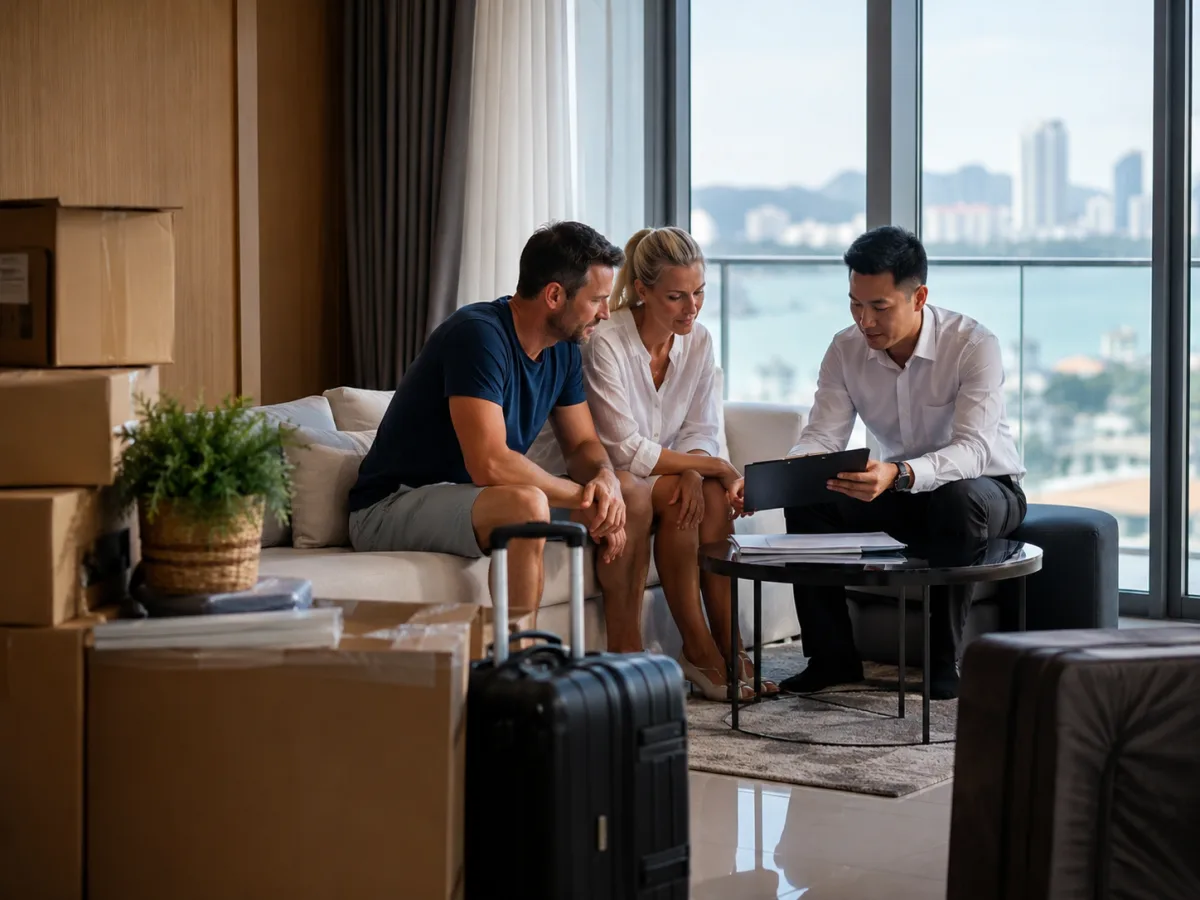
Many international buyers discover their dream condo in Pattaya online and then face the question: do I really have to fly to Thailand to buy it? The short answer is no. With a correctly issued power of attorney, the entire purchase process can be managed from your home country.
This article shows exactly how a remote purchase works, which documents you sign, what your appointed representative handles at the Land Office, and where the real risks lie. We have covered the legal basics of foreign ownership (the 49% quota, freehold) separately in our article Buying a Condo as a Foreigner – Legal & Secure; here we focus exclusively on buying without travelling.
Is buying a condo without travelling to Thailand really possible?
Yes. Thai law allows you to be represented by an authorised person for the ownership transfer at the Land Office. So you do not have to sit at the official's desk in person. In practice, this role is taken on by an independent Thai lawyer whom you expressly authorise for precisely this transaction.
Important to understand: the power of attorney replaces your presence, not your decision. You review the sales contract (Sales and Purchase Agreement, SPA) in advance, you decide on the price and terms, and you release the funds. Your representative only carries out what is clearly set out in the wording of the power of attorney.

The right power of attorney: form Chor 21
For condo transfers, the Land Department accepts only its own form: Chor 21 (for houses and land it would be Tor Dor 21). A self-drafted or merely translated text will not be accepted at the counter.
- Specific rather than general: The power of attorney should name the exact unit (project name, building, unit number) and the permitted actions precisely. A blanket general power of attorney is risky and is often rejected at the Land Office.
- Notarisation: You sign the form before a notary in your country of residence. The notary confirms your identity and signature.
- Legalisation by the Royal Thai Embassy: The notarisation must then be over-certified by the Royal Thai Embassy or consulate. Thailand is not a member of the Hague Apostille Convention, so an apostille is not sufficient.
- Thai translation: If the document is in English, the authorities usually require a certified Thai translation.
- Validity: Such a power of attorney is typically valid for around three months from signing, so plan its expiry to align with the transfer date.
Note: This is not legal or tax advice. Forms, deadlines and fees change, so have the specific power of attorney and the current requirements reviewed by a qualified Thai lawyer, and if necessary the relevant embassy, before proceeding.
How the remote purchase works step by step
- Selection & remote viewing: We show you the unit by live video, send floor plans and photos, and review the location, floor and view together with you.
- Reservation: A reservation payment holds the unit for you; the terms are fixed in writing.
- Due diligence: Your lawyer checks the title (Chanote/title deed), the 49% foreign quota in the building and any encumbrances.
- Sales contract (SPA): You receive the contract for review – including exit and deposit clauses – and sign it remotely.
- Power of attorney (Chor 21): Have it notarised, legalised by the Thai Embassy and sent to the lawyer.
- Money transfer: The purchase price arrives in foreign currency from abroad; the receiving bank issues the FET document (see below).
- Transfer: Your representative attends the appointment at the Land Office, pays the fees, signs and collects the new title deed in your name.
What your representative handles at the Land Office
A good, independent lawyer is the single most important safeguard in a remote purchase. They take care of:
- Reviewing the title deed and cross-checking it against the seller's document
- Checking the foreign ownership quota in the building
- Correctly calculating and paying the transfer fees
- Signing the transfer documents in your name
- Collecting the title deed transferred into your name
Where possible, avoid being represented by the seller or developer themselves – your own lawyer protects only your interests.
Bringing money into Thailand correctly: the FET form
Foreigners may only acquire a condo in freehold ownership if the purchase price was transferred from abroad in foreign currency. For amounts above roughly 50,000 USD, the receiving Thai bank issues a Foreign Exchange Transaction Form (FET). This document is the mandatory proof that the capital was brought in – without the FET, the ownership transfer at the Land Office cannot be carried out. Make sure the purpose of the transfer and your name are stated correctly.
What costs arise on transfer?
The government fees are due on the transfer day at the Land Office and are separate from the lawyer's fee. The usual split is negotiable and should be settled in writing before signing.
| Item | Amount (guideline) | Usually paid by |
|---|---|---|
| Transfer fee | 2% of the official appraised value | Buyer (negotiable) |
| Stamp duty | 0.5% (for a holding period over 5 years) | Seller |
| Specific Business Tax | 3.3% (for a holding period under 5 years) | Seller |
| Withholding tax | progressive, depends on the case | Seller |
On top of this, budget for the lawyer's fee, translation and legalisation costs, and notary fees in your home country. All figures are guidelines – the actual tax burden depends on the individual case.
What are the risks of buying via power of attorney?
Remote buying is well established, but not without pitfalls:
- Errors in the document: An incorrect unit number or owner name makes the power of attorney invalid and delays the transfer.
- Too broad a power of attorney: A general power of attorney without clear limits is dangerous – keep the scope narrow.
- The wrong representative: Anyone who lets the seller represent them hands over control.
- Deadlines: The roughly three-month validity must not have expired by the transfer day.
All of these risks can be defused with clean, specific wording in the power of attorney and an independent lawyer.
Frequently asked questions
Do I have to come to Thailand in person to buy a condo?
No. With a correctly notarised and legalised power of attorney (Chor 21), your lawyer can handle the ownership transfer at the Land Office entirely in your name. Many buyers still travel to the transfer appointment voluntarily – but it is not mandatory.
Which power of attorney do I need to buy a condo in Thailand?
The official Land Department form Chor 21 for condominiums. It must be signed before a notary in your country of residence and then legalised by the Royal Thai Embassy; an apostille is not enough.
How do I pay the purchase price from abroad?
By international transfer in foreign currency to a Thai account. For amounts above roughly 50,000 USD, the receiving bank issues the FET form – the mandatory proof for the ownership transfer as a foreigner.
How long does the whole remote purchase take?
That depends on embassy appointments, dispatch of the documents and the Land Office appointment. Allow a few weeks for notarisation and legalisation of the power of attorney, and coordinate the process closely with your lawyer.
Is buying via power of attorney safe?
Yes, provided the power of attorney is specifically worded, an independent lawyer executes it, and the flow of funds is cleanly documented via the FET form. The biggest risks are formal errors and too broad a scope of authority.
Remote buying works particularly well with off-plan projects: you reserve the unit, sign the contract and power of attorney remotely, and pay the purchase price conveniently in instalments over the construction phase – we coordinate every step on the ground, from the remote viewing to handover. You can read what to look out for in our guide Buying Off-Plan in Pattaya. If you would like to think through your remote purchase in concrete terms, arrange a free initial consultation or first download our free guide – honest, with no sales pressure.
Free Guide
68 pages of Pattaya insider knowledge — download for free